Monday, January 2, 2012

Movies of 2011, day one: cinematic films

I'm not sure why so many best/worst lists appear on the internet during December; aren't the authors afraid they might miss something of real significance during the last few weeks?

Now that it's 2012, I feel confident sharing my thoughts on the various media I encountered in 2011, whether they were originally released in 2011 or earlier. I'm going to delve into films, books and comics and my goal is to maintain a fairly positive attitude, even when I'm discussing the items I didn't care for.

All this week I'll be looking back at films I watched in 2011. It was a fairly significant year in terms of what, why and how I was watching older movies, but I'll get into that tomorrow. Today's topic: theatrical films.

I made only five trips to the cinema in 2011, albeit I might taken in even fewer films if circumstances had been different.

First, there was the Eagle, a film about a Roman soldier who wanders around early England searching for an eagle figure his father left behind. My brother Matthew could probably speak to whether this film was historically reliable at all. I wouldn't have imagined going to see the Eagle myself, but a friend wanted to see a movie with me and the other option handed to me was Battle: Los Angeles; I'd like to think I made the right choice. The Eagle was an okay adventure flick.

I was concerned that Thor would be somewhat disconnected from the other Marvel super hero movies which have been produced in the lead-up to 2012's Avengers, what with the vast cosmic/godly locales and characters required by Thor's mythos and their being rather removed from the relatively down-to-Earth Iron Man (and so forth). I felt my concerns were pretty well borne out - the movie worked well when it struck a little closer to the familiar (Earth scenes) and was just a bit off when it ventured into Asgard. Still, the movie works just fine, it's only serious misstep is the disjointed "romance" between Thor and Jane Foster, which feels as though at least one scene were omitted.

X-Men: First Class, on the other hand, was better than I thought it would be...probably because I've come to expect so little from the X-Men's movie franchise. It was a little too cute and self-knowing (Xavier's jokes about being a professor and going bald were at least one too many; gratuitous Wolverine cameo, so forth), but I felt its version of Magneto was actually the most formidable film version thus far. I'm not clamouring for more (nor does anyone else, it seems), but this was a great diversion.

Captain America: the First Avenger is the super hero movie I was most looking forward to; Avengers is a postscript in comparison. Cap has long been my favourite super hero and I felt the film did a great job at giving the character the attributes which make him likeable, particularly by emphasizing how his sense of courage and morality existed before he became a hero. I feel the film loses its way a little once he dons the final version of his costume (the pace of the story suddenly jerks forward) and the final ending doesn't quite fit (I'm assuming it was originally meant to appear post-credits), but overall I am very pleased with this movie

My family often takes in a movie over the Christmas holidays and 2011's feature was the Adventures of Tintin, which we of the younger generation paid for on our parents' behalf. I wasn't sure about the film in advance since the CGI style seemed so unlike the visuals of the original comics, but Tintin turned out out to be a great bit of fun, the right sort of movie to see with your family at Christmas. It did a lot to remind me about the Tintin comics, which I hadn't really thought of for some 20 years.

Tomorrow: great film discoveries of 2011!

Thursday, December 15, 2011

Joe Simon, RIP

This is shaping up to be a bad week for comic book professionals. Not only did we lose Jerry Robinson earlier this week, today we lost Joe Simon.

Joe Simon was a writer/artist/editor whose early efforts at Marvel included the Fiery Mask...but we're bound to remember him for ages to come because, with Jack Kirby, he created Captain America! The Simon-Kirby partnership went on for more than a decade, through just about every genre of comics (even creating a new genre - romance comics - together). When they parted ways in the 50s, Kirby went on to bigger and brighter things. Simon? Well, he was still out there, but never really an equal to Kirby again.

Personally, I'm very fond of Simon's 1970s DC comic Prez, which told the story of the USA's first teenaged president and his trials against chess-playing robots and vampires. Even by 70s standards, it was too bizarre to last.

We were fortunate to have Simon around as late as we did (he was 98). The giants of the Golden Age of comic books are slowly passing on...show your appreciation while you still can!

Wednesday, December 14, 2011

Today's riddle

Q: What do you get when you cross Triton...

...With the Eel...?

A: I don't know either, but he's on the cover of Deathstroke#7!

Tuesday, December 13, 2011

I Love Atlas Comics#17: "the Brain Trap!"

This story, this... man alive, this story. I can't do it justice my mere words, you must experience it for yourself; courtesy of George Roussos and World of Suspense#5 (1956):

At times I've been so disparaging to contemporary comics that I feel I have to point this out: Sturgeon's Law applies to every point of history in popular culture. Atlas Comics really suffered under the Comics Code Authority; even though they had some terrific talents who could make the most of the situation - Jack Davis, Joe Maneely, John Severin, Russ Heath - I frequently find post-code Atlas to be some of the dullest comic books ever written. World of Suspense#5 is tremendously dull, not even the Bill Everett story is worth consideration.

Here then we have a story about a man trying to invent a new "skin cure," instead cures baldness, then - nearing the end of the story - discovers he's also become telepathic! The page 4 action sequence has some of the most awkward fight choreography I've ever seen, as the attacker goes from throwing a stool over his head to banging his head against a cabinet which springs out of nowhere. I realize the Code occasionally restricted fight scenes, but that's no excuse for such a poor set-up and follow-through. Even with the caption explaining the scientist has stepped aside (to dodge the stool, not the following lunge), there's no sense of how the attacker is suddenly trying to tackle him, nor where the cabinet came from.

I feel this was being made up as they went along; I feel Roussos needed the money; I feel a regular diet of stories like these helped urge Stan Lee to give up on the comics industry.

In a better world, this would be a delightfully funny piece of unintentional comedy. The closing line "To grow hair would be a good thing... but the other things the formula can produce could be EVIL!" offers a glimpse at what might have been.

Monday, December 12, 2011

Nick Spencer, comicdom's answer to Ingmar Bergman, part 3

From Secret Avengers#13, page 5, art by Scot Eaton:

In the above: Washington DC is besieged by Nazis in giant robot suits in an all-out Blitzkrieg attack; the Beast races to the US Capitol to confront a congressman who refuses to evacuate.

Not seen here: Washington DC; Nazis in giant robot suits in an all-out Blitzkrieg attack; the US Capitol.

Net result: The Beast races past some bodies into some building for some reason.

Sunday, December 11, 2011

A gun-based exercise regimen? Must be made in the USA.

An advertisement from Combat#8 (1953):

So this is how Hoppy built his muscles? He must've had a bad case of trigger-finger. Build big arthritis as "Hoppy" does!

Friday, December 9, 2011

The films of Jack Benny

Some time ago, I read Joan Benny's biography of her father, Sunday Nights at Seven: the Jack Benny Story. Helpfully, the book contains extensive passages which Jack intended to run in an autobiography he never completed. At one point, Jack discussed his film career and wrote happily about his one picture, To Be Or Not to Be, but advised fans interested in his work to avoid the rest of his filmography.

It was a fine thing for Jack to ask his fans to forget about his film career, it's another for us to obey. I had already seen To Be or Not to Be by the time I read the biography, but I went on to see two more of his pictures. The Meanest Man in the World was undistinguished, but not too bad and at least had some choice lines for Eddie Anderson. On the other hand, Buck Benny Rides Again was about as close as a movie could come to Jack's radio program, with almost every cast member and even an audio-only Fred Allen putting in appearances; and yet, Buck Benny didn't quite satisfy me. It's a neat curio, but felt "off," just as I find his television programs don't entirely click with me.

Perhaps I should have stopped questing for Jack's films then and there, but within the last week I watched three more of them. Having done so, I feel compelled to share what I learned; hey, you don't have anything better to read, right? Charley's Aunt
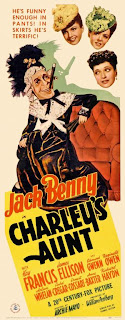
Charley's Aunt (1941) came up in scattered references via Jack's radio show, even post-war. It's just one of several film adaptations of a then-popular play, but as I have familiarity with the play, it was as good as new to me. Jack is an English university lad (who's spent 10 years in school) whose roommate Charley asks to pose as his wealthy aunt so Charley and another friend have a chaperone for their dates on the day they each intend to propose. Charley's real aunt turns up as well, using a false identity for her own reasons. So, it's a farce, basically looking for an excuse to get a man to wear drag. It also features Edmund Gwenn as the guardian of the two young ladies; Gwenn needs to give his consent for them to marry, so Jack's character is encouraged to woo him into writing his consent. It brings to mind Gwenn's alleged deathbed quote, "Dying is hard; but not as hard as comedy."

Because Jack's character spends most of the picture in drag, he's given very masculine characteristics, notably being a boozer and womanizer. This is very odd for a Jack Benny fan, as I'm used to the set-up where Phil Harris is the local drinker and skirt-chaser to contrast against Benny. Just as the radio program realized it was occasionally very funny to have Harris play against his type by taking a feminine role, the film takes the not-very-masculine Benny and places him in a role meant for a stronger, alpha male type, except the latter doesn't fit.

Of course, Benny isn't English either, which is the other odd part about him being cast in the film. Jack uses an exaggerated accent on the word "can't" (ie, "cawn't") throughout the picture, but that's about as much effort as he makes to sound English. Once you start to notice the accent, it actually becomes very funny, so much so that I wonder if Jack was doing it intentionally, much like his broad attempts at caricatured accents on the radio...and I wonder if the director knew what Jack was doing.

Charley's Aunt isn't terrible, probably because of the original source material. It's odd, but it isn't Jack's worst film. George Washington Slept Here

George Washington Slept Here (1942) is a frustrating picture - frustrating because it comes so close to working. The film features Benny and Ann Sheridan as a couple who purchase a dilapadated old New England manor with supposed ties to the Revolutionary War and attempted to fix the place up until it's fit to live in, but along the way they suffer monetary troubles, family growing pains and accusations of infidelity. So, it's Mr. Blandings Builds His Dream House then, isn't it?

Unfortunately, just about everything Blandings did right, George Washington gets wrong. Too many of the jokes are delivered in an episodic manner, instead of being tied to the overall narrative, as in Blandings. A sub-plot about Benny's cousin joining an acting troupe goes a long way for a very slight payoff. A bratty kid is introduced who is so bratty that he drives you to distraction (ie, "why am I watching this film? can't I find a better distraction?). The family's rich uncle leads to a few good comedy routines, particularly as he tells an old anecdote with Benny correcting him on various details, yet claiming he hasn't heard the story before.

Probably the biggest misstep is in the climax; facing foreclosure, the family is saved when they unearth an old boot which contains a long-lost speech written by George Washington, validating the old claims about the house. Reciting the speech stops the comedy dead in its tracks and while the speech gives the family the capital they need to keep the house, it's not as strong as the resolution to Blandings, where the family solve their problems through their own ingenuity rather than a deus ex machina. George Washington Slept Here is my least-favourite of Benny's pictures. The Horn Blows at Midnight

Of course, the most infamous picture Benny ever made was the Horn Blows at Midnight (1945), a movie he mocked for so many years (decades?) that you would suppose it were something truly terrible. It's a picture with some serious troubles, but it's not that bad. Jack plays a musician who dreams he's an angel who's been charged with going to Earth and playing four notes on a celestial trumpet at the stroke of midnight which will usher in the end of the world; unfortunately/fortunately, various parties get in his way, including a pair of fallen angels who have taken up residence on Earth and don't want to see it go away.

The Horn Blows at Midnight was allegedly a box office bomb, hence Jack's many jokes about the film's quality. I can believe this film would have had trouble during its release. The movie's entire premise is that the protagonist is having a dream; how are you supposed to entertain an audience who know dreams "don't matter?" Unlike, say, Buster Keaton's Sherlock Jr., it isn't fanciful enough to make the dream worthwhile, despite the director's efforts. Raoul Walsh was the film's director and he was a top-drawer talent; early scenes set in heaven with thousands of angels playing instruments are gorgeous, particularly one shot which flies over the orchestra. Walsh clearly made the film with a bit of love, so there are some things worth seeing in the picture. The other really fine bit in the picture is a waiter played by John Brown who is a typically entertaining John Brown character.

Outside of the visuals and the performances by Benny and Brown, I can't say much in favour of the Horn Blows at Midnight. Even moreso than George Washington, it feels like a collection of sketches. There's a thief, his ladyfriend and strongarm clinging to the edges of the story, along with the fallen angels, Benny's love interest, Benny's boss, a hotel detective, a wealthy dowager and about a dozen even less important characters. Strangely, the radio adaptation works in about every way this picture doesn't; the radio version dispenses with the business about the dream and instead of coming up with humourous reasons why Jack is distracted from blowing his trumpet, has characters argue for humanity's survival, until Jack himself is convinced. The Horn Blows at Midnight shouldn't have been a Warner Bros. picture - it really belonged at Columbia, where Frank Capra could've had a chance at making it cohesive.

At any rate, the radio version is keen. You can download a copy via the Internet Archive.