Showing posts with label wally wood. Show all posts

Friday, July 5, 2019

There's nothing to get MAD about

Word has come out that Mad Magazine is about to be cancelled. I have never been a regular reader of Mad, but the news brought a few things to mind.

There are three good reasons I can see why it has happened:

  1. The magazine format is (unfortunately) a dying medium and Mad relied heavily on newsstands and subscriptions.
  2. Their parent company, Warner, folded them under DC Comics' umbrella to save money and they've never been comfortable as a cog in a corporate machine.
  3. They're not relevant.

To that last point, do you realize it's been 25 years since The Simpsons mocked Mad's toothless humour in the episode "Bart of Darkness"? ("'The Lighter Side of Hippies.' They don't care whose toes they step on!"). I mean, 25 years! The Simpsons themselves have been toothless and irrelevant for the last 20 years!

People of a certain age (ie, older than me) wax nostalgically about how subversive Mad was in its heyday, that it was a real "truth to power" publication (Mike Sterling has a nice reminiscence here). And even in my junior high years, kids who brought Mad to school were rebels.

Yet, for all that, I can't recall a time among my friends or online where someone asked, "Hey, did you read that new issue of Mad?" Like, there was never a standout story which got people talking. Instead, Mad had a sense of sameness; you might ask, "Have you ever read a Spy vs. Spy?" but never ask, "Have you ever read this Spy vs. Spy?" I feel like after reading a certain number of Mads one reached their limit and didn't need to read more. The names of the celebrities and movies being parodied might change, but little else did.

It was just two months ago that I read the four volume set The Mad Archives, which cover the first 24 issues of Mad, comprising all of the full-colour comic book-format issues plus the first issue of the magazine format. Those issues were the product of Harvey Kurtzman, a brilliant humourist, but at times the archives were a struggle to get through. For the first two years of publication, Mad was a bi-monthly comic, but in its third year it went monthly and that seems to have been more than Kurtzman could manage. The book got a bit tedious in its third year because Kurtzman was so clearly trying to fill up pages to make deadlines instead of assembling quality material. There were far too many pages with recycled art, photo captions or even next-to-no-content (the 'joke' being that the page would be practically blank or illegible) again and again.

And yet, Mad really was something special. In those issues there were running features by Wally Wood & Bill Elder which mocked popular comic strips or comic book characters and the first few movie parodies showed up. Among those parodies was, of course, 'Superduperman' in Mad #4, a parody of Superman which turned out to be immensely influential on the comic book medium, as a young Alan Moore absorbed a lot of lessons on how to deconstruct super heroes from Kurtzman & Wood's jokes.

It's funny, though, that the magazine format Mad wasn't something I thought of as a comic book. Through my teenage years, I thought of 'comic books' as a publishing format, not a type of storytelling. I saw comic strips and Mad magazines as something separate--which, I later learned, was one reason why Bill Gaines was happy to transition Mad from the comic book format to magazines--comics books were seen as an exclusively children's medium, but magazines were not. It was a shrewd move for Gaines (and also something Kurtzman demanded, but Kurtzman walked off Mad only a year later; he went on to create Trump, Humbug, and Help!, but none of them really stuck).

I have a lot of admiration for many of Mad's usual gang of idiots: Kurtzman, Wood, Elder, John Severin, Sergio Aragones, Al Jaffee, Dave Berg... and I was impressed that at times they attracted some of my favourite non-comics humourists like Stan Freberg and Bob & Ray. I'm glad that for more than 60 years, there was a place for Mad in this weird little world of ours. I read very few issues of Mad, but I was happy there was a continually successful comics publication that wasn't a super hero book. RIP Mad. And, by extension, this is the true death of EC Comics.

Wednesday, October 19, 2016

Bradbury 31, Day 19: "There Will Come Soft Rains"

Yet again, I'm looking back on a Ray Bradbury short story which is best-known for comprising part of The Martian Chronicles. "There Will Come Soft Rains" debuted on its own in 1950 just ahead of the book itself. It is a very well-regarded Bradbury tale; I have one friend who a great fan of science fiction throughout the 20th century and while he's not much of a Bradbury fan, he believes this story is among sci-fi's finest.

In 1950 the radio show Dimension X adapted the story as a double feature alongside Bradbury's "Zero Hour" - a rather different tale of Mars. The computer voice in this version has a staccato rhythm which really sticks in the memory ("Today is October 6, 2026..."). You can listen to the show at archive.org here.

Al Feldstein and Wally Wood adapted it to EC comics in 1953 and did a fine job. Comic book versions also include the 1992 Topps version by Lebbeus Woods (which was published side-by-side with a reprint of the Feldstein/Wood version) and as part of Dennis Calero's The Martian Chronicles graphic novel. It is also one of the rare Bradbury tales to be animated; the animated version was made in 1984 by a Soviet animation studio and it is, if anything, more grim than Bradbury's text. In all, "There Will Come Soft Rains" is a fine representation of nuclear anxiety, the fear of the cataclysmic effects nuclear war would have on civilian populations. "Not one would mind, neither bird nor tree, if mankind perished utterly; and spring herself as she woke at dawn would scarcely know that we were gone - that we were gone - that we were gone - that we were gone..."

Another Ray Bradbury tale tomorrow!

Monday, October 17, 2016

Bradbury 31, Day 17: "Mars Is Heaven!"

Ah, here we go. "Mars Is Heaven!" is one my personal favourite Ray Bradbury stories. Although it was first printed as a short story in 1948, it's best known for appearing as a chapter of The Martian Chronicles and has also been adapted there, both in the TV movie and the Dennis Calero comic book version.

1950 was a hot year for Bradbury; The Martian Chronicles became renowned, granting him prestige he'd previously lacked. Radio loved Bradbury and they adapted "Mars Is Heaven!" twice that year on different network programs: Escape (listen to it at archive.org here) and Dimension X (at archive.org here). The two versions are rather different, with Escape being very faithful. Both tell the story of a human expedition to Mars which discovers a homey U.S. town (from Illinois because it's Bradbury) transplanted to Mars and all the beloved dead ones of the crew residing there. In the climax, the ship's captain realizes the "loved ones" are actually Martians in human form.

Although I normally like adaptations to be as close to the original text as possible, the Dimension X adaptation adds something which I rather like; a new character is added to the crew - a physician who had survived the Dachau concentration camp. A lonely and traumatized man who can no longer recall his family, he finds no one on Mars waiting for him amongst the "dead" - and thus he comes to the realization of what the people truly are.

In other adaptations, such as the 1953 EC comic by Al Feldstein & Wally Wood, the captain comes to the conclusion of the Martians' identity on his own, which renders it something of a solliloquy. The revelation of the Martians' identity is followed by a macabre scene in which the Martians bury the dead humans, which EC and the Escape version kept.

However, the 1989 Ray Bradbury Theater version ends at the moment of the captain realizing what the Martians are. That program had a distinct problem with depicting action - so many episodes would climax at the very moment of the twist, rather than playing any of it out (namely, the death of the captain).

Show up tomorrow for another look at Ray Bradbury!

Saturday, October 1, 2016

Bradbury 31, Day 1: Kaleidoscope

Each year I like to celebrate the month of October with posts which are somewhat Halloween-themed. This year I've chosen to celebrate the career of Ray Bradbury, my favourite author to dabble in weird fiction - although he dabbled in virtually every other genre you care to name. Each day I'll bring up one of his short stories and examine the many times that story has been adapted.

"Kaleidoscope" originated as a short story in 1949. It tells of a rocket being lost in space and its former occupants spilled out, each carried in a different direction. Using the radios in their spacesuits, the men speak to each other as they prepare to meet their deaths.

"Kaleidoscope" was a popular adaptation on radio, appearing on a 1951 episode of Dimension X (listen at archive.org by clicking here), a very good 1955 Suspense episode where the actors recorded their lines while confined in separate booths to better capture the isolation of their characters (listen at archive.org by clicking here), and a 1984 broadcast of Bradbury 13 (listen at youtube by clicking here).

The first comic book adaptation of "Kaleidoscope" is a rather notorious comic book story called "Home to Stay" which Al Feldstein wrote and Wally Wood drew for EC Comics' Weird Fantasy #13 (1952). Although it's not really an adaptation of the story, the climax of the tale is an utter rip-off of Bradbury's tale. Subsequently, Bradbury contacted EC and, as Mark Evanier describes here:

He noted that the adaptation was well-done and that the two stories had been rather cleverly intertwined, the whole being greater than the sum of its parts, so to speak. Suing might cost a lot, he knew, and there probably wasn't much money to be collected…so he tried another approach. He wrote Gaines a letter that said, in essence, "You seem to have neglected to pay me for the adaptation of my work." Gaines sent a modest check, a brief correspondence ensued and EC wound up adapting many of Ray's stories on an official basis.

"Home to Stay" is now officially acknowledged as a Bradbury tale, appearing alongside other Bradbury comic book adaptations as collected by Topps Comics in the 1990s. Speaking of which, in 1994 Topps issued a brand-new adaptation in the title Ray Bradbury Comics: Martian Chronicles, even though the tale has nothing to do with his Martian stories. "Kaleidoscope" was adapted by Howard Simpson, using big panels and splashes, evidently to emphasize the vastness of space in which the astronauts had been lost. In a new introduction Bradbury dedicated the tale to the Challenger astronauts.

More Bradbury tomorrow!

Friday, September 30, 2016

"Only one thing to do... go all the way!" Heroes, Inc. #1 review

To follow yesterday's His Name Is Savage #1 review, let's turn the clock ahead by one year to 1969 and Wally Wood's Heroes, Inc. #1, first of an aborted anthology series.

Wally Wood drew some of the most appealing art to ever grace the comics medium. He drew gorgeous gals, tough guys, weird creatures and wrote plenty of funny gags. With Heroes, Inc. he had an opportunity to step away from the major publishers and do his own thing; it was at this time he was producing his immensely fascinating pro-zine witzend. Marketing this new book to military bases offered a chance to be a little more adult and sophisticated.

Joining Wood for the lead feature, Cannon, was Steve Ditko; the duo had previously worked together on T.H.U.N.D.E.R. Agents and would collaborate again on Atlas' Destructor (issue #1 covered here). Ditko would also unveil his first batch of Mr. A comics via Wood's witzend. Yet for all that, they're not an obvious collaborative team; Wood drew lovely ladies while many charged Ditko incapable of that; Wood liked free-wheeling sick humour while Ditko was (and is) a very tightly-wound conservative. And yet, Cannon would prove to be the one section of this book to truly catch on. Cannon is a CIA agent who suffered brainwashing at the hands of Communist agents; the CIA couldn't reverse his condition so completed his brainwashing to make him the perfect CIA killer - at the cost of his emotions. In this tale, Cannon is sent to rescue a beautiful woman who holds vital knowledge of the US's anti-missile defenses. It's really not that different from His Name Is Savage, except done in fewer pages with lots more vitality. Also, Cannon has an identifiable hook as a character - his emotional detachment.

The second feature, Misfits, is an odd science fiction tale. The Misfits are Mystra (psychic woman), Shag (tiny furry psychic alien) and Glomb (giant mutant). In this tale they meet each other while being held by the government and come to the Earth's rescue when alien invaders begin conquering the planet with their own mental powers. There's a funny non-PC moment I quite enjoy regarding the invaders:

Reporter: "A man just emerged from the ship... hey! It's a white man..."
Off-panel advisor: "Well, that's a good sign anyway... try to talk to him!"
Reporter: "No... I mean white! Like a sheet of paper!"

The Misfits breezes by a little too fast, given the many characters with various origins and the matter of an alien invasion! It's certainly not boring - and it certainly helps that Wood loaded his pages with panels (12 panels on one page!), but it's not as neatly done as Cannon.

And yet there's still more: a third feature, the comedic Dragonella. A beautiful lady has been raised by a race of saurian creatures; one of them, St. George, is smitten with Dragonella, but she wants a handsome man. Accompanied by St. George she begins her quest and encounters one Prince Hal (parody of Hal Foster's Prince Valiant). It's all basically an excuse for jokes about the fantasy genre with a few mild sex references. My favourite bit is above, where Dragonella suddenly begins talking like a comic book action hero as soon as a fight scene begins.

That's all for this book; Cannon would return a little later as a strip Wood prepared for the army. It contained all the lurid sex & violence Wood specialized in. Heroes, Inc. would not see another issue until 1976 via a different publishing team. Wood efforts in witzend and elsewhere contributed a lot to the eventual success of independent comics, but Heroes, Inc. was something of a dead end in its own time. Still, I feel it holds up much better than Kane's His Name Is Savage. Give it a whirl, if only for a few laughs at Dragonella.

Tuesday, November 25, 2014

"If you want to be good at this, you need to do your homework." DKW review

In his comic DKW: Ditko Kirby Wood, writer/artist Sergio Ponchione argues Steve Ditko, Jack Kirby & Wally Wood were (and are) the "trinity" of comic books. In this comic, a veteran comic book creator describes Ditko, Kirby & Wood to a novice artist and his descriptions of each man's work are told through pages illustrated in a style similar to the artist at hand. Ponchione's ability to mimic them is quite a feat - it's not indistinguishable from the real thing, but it is something to see an artist of this time who can draw upon the skills of a true comic book master (much less three of them!).

I grew up on comics in the shadow of Wood's death and a time when Kirby & Ditko had been relegated to less-visible, less-prestigious books. In due time, as a huge Marvel Comics fan (and eventual freelancer for them), I came to explore and love their Marvel work. It took longer for me to step into their non-Marvel work or take an interest in their personal lives (which, I tend to prefer creators keep personal, so I don't begrudge Ditko's quiet withdrawl from the comics scene at all).

Ponchione's Kirby pages seem to be drawn almost exclusively from the pages of the Eternals (note the structure above which is based on the Celestials' Mothership) which suits me fine, it being my favourite Kirby series. Both the Kirby and Ditko pages celebrate the imaginative work produced by those men without any real gray clouds.

However, Wally Wood seems to provoke melancholy wherever his name is mentioned due to how his final years played out. For a long time I didn't know his name - and even when I did see people discussing it, I didn't understand why. In that regard, I could have used a copy of DKW about 15 years ago to educate me on why he's considered a legend. Ponchione seems to have recognized this as he spent quite a bit of text on Wood's style and innovation.

DKW is perhaps something you could hand to a friend who doesn't know too much about Ditko, Kirby or Wood. I already knew those names - but now Sergio Ponchione is another name I'll have to revisit.

Saturday, November 1, 2014

Unearthed: All-Star Comics#63

Three years ago I initiated the "Unearthed" feature on this blog with a look back at All-Star Comics#62, a comic from my childhood. I noted then that I had never read the subsequent issues to find out how the story ended; happily, in the intervening years I've obtained a copy of All-Star Comics#63 and it pleases me now to crack it open.

The story left off last issue with Superman & Supergirl encased in lava by the creature Zanadu, who had kidnapped Hawkgirl. Meanwhile, someone had brainwashed Wildcat to attack Hawkman. The other members of the Justice Society were likewise engaged in subplots, centered around Doctor Fate's recent near-death.

The cover (by Rich Buckler & Wally Wood) feels a little off with its ridiculously immense Solomon Grundy; at least the presence of the Fiddler here lets us know he was the one playing the music which brainwashed Wildcat.

The story is titled "The Death of Doctor Fate" and the creators are Paul Levitz, Keith Giffen & Wally Wood. Notably, this confirms that series author Gerry Conway was indeed on his way out in the previous issue. Therefore, this issue ought to be fashioning something a little more stable, direction-wise.

Under the Fiddler's instructions, Wildcat easily beats Hawkman unconscious; Solomon Grundy simply stands and watches. They helpfully note they're representing the Injustice Society, the JSA's foes, but why are they attacking now? They have nothing to do with the Zanadu threat. That said, heck, it makes a lot of sense - why should villains respect the queue? If someone ever told Doctor Doom to attack the Fantastic Four while they battling Galactus we'd probably see no more Fantastic Four stories.

Of course, the Fiddler ain't exactly Doctor Doom; he stops playing his fiddle which releases Wildcat from his control, giving Wildcat an opportunity to beat him up. Let's face it, Wildcat may be little more than a cranky old boxing freak, but without his instrument the Fiddler's just an old freak. Grundy steps in at this point and Wildcat has no hope of beating him, but Power Girl & Superman arrive to save him. This moment feels like quite a misfire - the threat of Zanadu has (somehow) been pushed to the rear for the fight with Grundy & the Fiddler. Although Superman describes how they escaped the trap, it isn't depicted. The duo quickly finish the fight with Grundy by throwing him into a volcano (overkill much?).

Although Power Girl & Superman escaped their own prisons off-panel, they explain they didn't do the same for Hawkgirl - thus, truly nothing has changed since last issue; the (unclear) menace of Zanadu was simply deferred. We do, however, get a simply terrific close-up of Superman's face - very Woody, a rendition quite evocative of Joe Shuster. The likeness is a visual reminder that the Superman appearing in this comic is supposed to be the Golden Age Superman; that term really had some play in the early 70s nostalgia craze - the Golden Age of Film, the Golden Age of Radio, the Golden Age of Comic Strips and the Golden Age of Comic Books all experienced a boost in reputation. This image is so good, even Wildcat's presence doesn't ruin the panel.

The scene shifts to Egypt as the Flash & Green Lantern are searching for some means to help save Doctor Fate's life on the flimsy reasoning that because Fate's origin happened there, there must be a cure. Egypt seems a little too big for them to stumble across a cure, but they do stumble across a man upon a winged horse, thus furthering the man and his unusual horse from the previous issue. However, that's as far as this subplot moves for now. The man on horseback remains unidentified (yet obviously the Shining Knight to those with long memories).

Returning to the Justice Society of America's headquarters, Doctor Fate is still hooked up to a machine which the Star Spangled Kid is using to channel cosmic energy to save his life (for some reason they put Fate back into his costume between issues). Doctor Mid-Nite (also back in his costume) and Hourman both watch helplessly and, man, Wood makes these two look great! Their darker colours really seem to suit Wood's lines. As they're my two favourite JSAers, I couldn't be more pleased. However, the heroes themselves have little to be happy with - Fate's brain activity ceases and the machines are shut off. Doctor Mid-Nite is so distraught by Fate's death that he rips off his mask and decides to give up being a hero, even as Hourman and the Star Spangled Kid are heading out to face Zanadu, who has mysteriously reappeared in New York.

At this point, Zanadu is pretty much a lost cause so far as a villain goes; he's been kept off-panel for most of the story while both his power level and goals are unclear. In this fight, Hourman gets to fly and shoot energy blasts thanks to the Star Spangled Kid, who surrounds him with an energy field to do so (but why? why not simply attack Zanadu himself?). The fight leads them back inside the JSA's base and Zanadu's presence causes Dr. Fate to wake up, as Zanadu is an agent of chaos while Fate represents order. Fate strikes Zanadu down while Hawkman saves Hawkgirl (off-panel). This causes Zanadu to lose focus on his power, having needed Hawkgirl to channel his energies to conquer the world. Fate then encases Zanadu within a block of amber, leaving him precisely where he had been at the start of the previous issue. Frankly, the best part of this fight is how Kirby-esque it becomes at times, likely because of Giffen's presence on pencils. Not only does his Zanadu look like a Fourth World character, but he gives Fate some impressive "Kirby crackle."

With the crisis past, we move into a one-page epilogue, wherein Superman announces his retirement from the Justice Society (a group he barely ever interacted with anyway) and insists his cousin Power Girl be promoted in his stead; Wildcat thinks this is an upset, but it settles the friction which Superman & Power Girl dealt with in the previous issue. The scene shifts again to the Injustice Society as the Icicle informs his (unseen) teammates they'll strike at the Justice Society through their weak link: Hourman! Wait, Hourman? The fellow who only rejoined the team last issue? Ah, whatever.

Thoughts: Considering that in the previous issue Conway was on his way out and Levitz in, it held together much better than this issue. This is a decent but unremarkable super hero story redeemed mainly by the artwork. The problems of the previous issue are dealt with too easily; how will Wildcat escape the Fiddler's control. Uh, the Fiddler stupidly lets him go. How will they save Dr. Fate's life? Zanadu steps near him and he instantly gets better. What about the Flash & Green Lantern's quest? Nothing to do with Fate's revival, as it turns out. And what of Power Girl & Superman being imprisoned by Zanadu? They get out of it off-panel. And what of Zanadu himself? He can't hold his own against the Star Spangled Kid, much less Dr. Fate. Fights are treated as curbstomps (Wildcat vs. Fiddler, Superman/Power Girl vs. Solomon Grundy, Dr. Fate vs. Zanadu), rather than aiming for high tension or serious peril for the heroes.

Perhaps Levitz was still clearing the deck of Conway's plots so he could get his own started, in which case the series might improve in the following issue. Even then, there's not much of a hook; more of the Injustice Society, when one of their most powerful members couldn't give the Society a decent fight? The very idea of Hourman as the weak link doesn't hold water; surely the Wildcat, the team's resident sourpuss and irritant is the weak link; heck, you could argue Power Girl is a weak link because of her short temper; Hourman's demonstrated nothing since his return except for a general sense of competance which only Hawkman & Superman have matched.

Still, man... that Giffen/Wood art... beautiful! Also, Wildcat was tolerable, which I consider a minor victory.

Sunday, August 17, 2014

Unearthed: The Destructor#2

Not content to give up after issue #1, I'm back for more of Atlas Comics' generic-yet-appealing super hero the Destructor!
Again we open with a Larry Lieber cover because - inexplicably - Atlas Comics did not realize advertising the fact that Steve Ditko served as the series' artist might bring in more readers (of course, covers were always done early; p'rhaps Lieber drew all of the series' covers before Ditko had even been hired). Take notice of the words "All New No Reprint" in the top right corner. By 1975, the comic book industry had certainly been overrun with reprinted stories and the publishers usually disguised the fact that said reprints were not all-new material. In fact, it's been alleged that the entire reason for Marvel expanding the number of reprint titles in their library was simply to crush Atlas, forcing them off their newsstands (theorizing that vendors could more easily sell reprints of Don Heck's Avengers or Werner Roth's X-Men than gamble on an unknown quantity such as Morlock 2001 or Demon Hunter). If the direct market had been a force in those days, Atlas might have stood a better chance.
Anyway, the cover also serves to introduce the issue's villain: Deathgrip. He doesn't seem that formidable here (if his right hand can emit crackles of destructive energy, why is he bothering with that hook in his left hand?) and the woman hanging off the girder is needless clutter. The previous issue's cover was a touch generic, but it did a better job of selling the Destructor.
This story is called "Deathgrip!" and is again brought to us by writer Archie Goodwin, penciler Steve Ditko & inker Wally Wood. We resume the Destructor's tale by visiting the fallout from the first issue. While Destructor's primary foe Max Raven is dead, his lieutenant Lash and his mob are still a concern. There's a nice Daredevil-like bit where the Destructor's superhuman senses alert him to a truck trying to drive him over while he's in the midst of a fight. With the rest of Lash's men down, the Destructor moves in on the leader, but Lash points out if he's brought down, the Syndicate will simply bring in another leader, just as Lash replaced Raven. He suggests the Destructor should strike at the Syndicate's leader Big Mike Brand, who lives on a ranch in Ransom, New Mexico. The Destructor swallows this story and sets out to investigate Brand.
Once the Destructor leaves, Lash meets with a shadowy figure (soon revealed as Deathgrip) as they conspire over how they've tricked the Destructor into bringing down the Syndicate so their true masters the Combine can take over. While Jay Hunter briefly flashes back over his origin story, Deathgrip hints at his own origin (apparently the Combine supplied him with his bionic right hand) while being self-aware enough to note "Subtlety can hardly be the stock-in-trade of anyone called Deathgrip!" However, Deathgrip isn't with Lash simply to conspire - the Combine wants Lash killed. Deathgrip does so, apparently by burning through Lash's throat with his hand (Ditko cuts away for matters of discretion). "See Lash? No subtlety!" Deathgrip remarks. Again, while the Destructor is a fairly average series, Goodwin's scripting is well above average.
While Jay sets off to New Mexico, thinking how prior to his father's death he used to idolize Big Mike Brand, Deathgrip checks in with the Combine. The Combine want Deathgrip in Las Vegas for a new assignment, but he insists on following the Destructor's actions. The Combine agree, provided he serve only as a last resort - the Combine don't want Brand's death to be traced back to their agents.
In the New Mexico desert, Jay catches a rattlesnake and uses it to startle Brand's horseback-riding daughter Angela, giving Jay an opportunity to win Brand's confidence. One can't help but notice inker Wally Wood always wakes up when it's time to ink a pretty girl (and all girls are pretty in Wood's comics). Jay's plan works and Brand invites him back to the ranch, although Brand's top bodyguard Pepe is suspicious of Jay. For good measure, Jay fouls up Brand's car so he can save the day again through his mechanic training.
Jay soon accepts a job offer as Brand's chauffeur and intends to tear Brand's empire apart from within. As a continuing premise, this isn't too bad; if Jay's double identity/purpose is discovered by these people, it's worse than losing a secret - it would mean his life. And you thought Aunt May gave Peter Parker a lot of grief! Over dinner with the Brands, Jay meets Angela's boyfriend Glenn Thorne, whose curly perm suggests an underlying menace.
That evening, Jay dons his costume and breaks into Brand's office where he discovers Brand no longer has anything to do with the Syndicate operations Lash had been dealing in. The Destructor is seen by Brand's guards before he can leave and they shoot him, but his healing powers again save his life. Elsewhere, Deathgrip hears about the break-in and fears the Destructor might know Lash lied to him; he decides to go against the Combine and strike immediately.
The next day, Glenn takes Angela for a drive to an auto dump, where he removes a mask and wig to expose himself (in a fully-clothed manner) as Deathgrip! He tells of his origins as a cardsharp who lost a hand in an auto wreck. He again uses "subtle," this time to describe his ability with cards, but notes with his new hand "I can never be subtle again!"
Soon, Deathgrip sends a message to Big Mike: get out of the country and don't turn anything over to the authorities, or Angela will die. Jay overhears this and has begun to think Brand might not be the terrible gang lord he once was; Jay decides he'll rescue Angela. At the auto yard, Deathgrip shows off the compactor and has Angela locked inside a car, planning to crush her if her father doesn't comply with his demands. Fortunately, the Destructor arrives. Although Deathgrip's bionic hand causes Jay terrible pain, his quick healing enables him to stagger through and eventually he manoeuvres Deathgrip under the compactor's crane; Deathgrip's metal hand causes him to cling to the magnet and the Destructor releases him in the compactor, crushing him to death. The Destructor leaves the auto yard with Angela, still wondering if he'll have to kill her father.
Thoughts: Not bad. Again, average and I didn't find Wood's inking as energetic as before - the first issue had a kind of softness about the lines, whereas this issue feels almost glossy. Still, I'm one of those who always enjoys Ditko's layouts and Goodwin is virtually unbeatable as a scripter, so it's still a decent package. This is a minor treasure - worthwhile for any fan of Ditko, Goodwin or Wood.
In the next installment of Unearthed: The Destructor#3!


Saturday, August 9, 2014

Unearthed: The Destructor#1

Or, INTRODUCTORY TO DESTRUCTORY!
Funny thing: after Hands of the Dragon I'd planned Atlas Comics' Destructor to cover my next few entries of Unearthed, when earlier this week Calamity Jon tackled Destructor on his site, Gone & Forgotten. Go read his article if you'd prefer a few laughs over my ramblings.
From the cover of the Destructor#1, it seems at first glance to be another undistinguished comic book like so much of what was crowding the spinner racks of 1975. The art here is by Larry Lieber & Wally Wood, hence why there's an effort towards Kirby-ish dynamism (Lieber) and a large-busted woman (Wood). It's our first look at the Destructor himself and there's not much you can say about a costume such as his; it's rather generic. Even the unique-looking pointed red tips travelling up his brow bring to mind DC's Hawk (he of and the Dove). I think the advantage of a simple super hero costume (such as Destructor's) is that when it's set against a detailed backdrop, it pops out. The disadvantage is that against a bland background, the figure is lost. Where does the Destructor fall? Read on...
The Destructor's debut story "The Birth of a Hero!" (cripes, even the title's generic) is written by Archie Goodwin, pencilled by Steve Ditko and inked by Wally Wood - so right there, there's your reason for bothering with this comic. If neither Ditko nor Wood are to your tastes then I can only suggest - perhaps you aren't that interested in comics? Goodwin has not been praised to the stratosphere as the two artists have and many of his plaudits are due to his work as an editor. However, he was a truly fine writer as well; I think most Iron Man fans would agree with me that he was that series' first truly fine author. Can these talented men sneak a quality hero past Atlas' publishers? Let us see...
Our setting is the exotic locale of Newark, New Jersey, where mobster Max Raven occupies his time with one hand in his pocket, watching his goons rough someone up. Hm. We meet Jay Hunter, a young delivery boy whose primary job in the Raven mob is to bring his boss the take from their numbers racket. Jay is interested to see them working over one of their own men and follows up this observation by suggesting he could be a bigger help to them. This inspires Raven to have Jay killed, rather than accept Jay into his ranks and get at least a few months of valuable service out of him before finalizing the matter. Raven's a little paranoid to think Jay should die for being ambitious, to put it neatly.
Jay goes to see his scientist father Simon, who disapproves of Jay's lifestyle. Simon believes the serum he's been working on will enhance the senses of whomever ingests it. Jay doesn't believe his father will ever obtain the funding he needs, but their conversation is interrupted by Raven's gunman Blitz, who shoots them both. Dying, Simon gives the serum to Jay, tells him to find something hidden in the lab closet, then perishes. The serum saves Jay's life, granting him a superhuman healing ability, but he's still sent to the hospital, suffering from nightmarish visions (excellently captured by Ditko). Hearing that Jay is alive, Raven has Blitz killed to prevent him from speaking. If this trend continues, Jay may not need to seek revenge on Raven, Raven might obligingly kill off his entire mob!
Jay sneaks out of the hospital and tries to lie low with some friends, but they want nothing to do with him (you can tell the gal above has more ink than pencil in her lines, eh?). Jay winds up hiding in his father's lab, where he accidentally discovers his enhanced abilities also include superhuman strength. In the hidden closet his father mentioned, Jay discovers a costume.
"Bringin' down Raven'll take somethin' more vicious... ...a Smasher, a Destroyer... a Destructor!"
Thus he decides upon his name and begins to strike back against Raven in his costumed identity, using his inside knowledge of the Raven mob to destroy their hideouts. Jay sends messages to Raven where he claims the Destructor is working with him to destroy Raven; the use of a double identity in this situation doesn't quite make sense to me as he's fighting Raven in both guises, but at least it rattles Raven so he wonders who Jay's new friend could be.
The Destructor's continued assaults upon Raven's mob coupled with Jay's constant taunts begins to wear upon Raven's reputation. He decides to call in the Slaymaster! We next witness Slaymaster as he goes into action against a gang in Ohio he'd been hired to kill. The Slaymaster wears normal-looking duds - a suit, sensible shoes, gloves and a quite Ditkoesque hat. He also has a large belt of gadgets (such as a rope), two guns and wears a net-like mask over his face (being Ditko, I'm not quite sure if the mask is supposed to be netting, cloth or perhaps nylon?). It's interesting to note that all of the people Slaymaster slays he shoots in the back; hardly a sporting one, he. Slaymaster accepts Raven's bid to have both the Destructor and Jay killed. Won't he be pleased when he finds out this job is actually a twofer!
At this point we're halfway through the story and the Destructor thinks back upon his father's death. Perhaps the story was originally intended to be broken up within an anthology, such as Atlas' Thrilling Adventure Stories? The Destructor heads to another of Raven's front companies, the Giant Novelty Co. Wait, seriously? Have we gone from Newark to Gotham City? Entering the factory, the Destructor walks right into the sights of Slaymaster, who successfully strikes our hero twice (the story would probably be over here but for Destructor's healing ability). The Slaymaster calls out to the Destructor, boasting of all the technology at his hands to help hunt the hero. The Destructor has nothing but his own hands and feet for weapons, but this new challenge encourages him to better understand how his powers work; through concentration, he learns how to better pinpoint his enemy's location and train his reflexes to dodge his attacks. It's in this sequence that Ditko finally gets to show off the kind of stylized acrobatics which are his forte. At one point Destructor leaps up and grabs a pipe in the rafters to avoid being seen by Slaymaster, but the noise of doing so gives him away. It's all one great cat-and-mouse contest until Destructor leaps on him and a gun goes off.
The Slaymaster seemingly returns to Raven to report on the Destructor's death, but it turns out to be the Destructor wearing Slaymaster's clothes. Before Destructor can have his revenge on Raven, Raven's lieutenant Lash bursts in with two gunmen and shoot Raven to death, blaming him for the destruction of their mob. The Destructor roughs up Lash and the others, then reveals his identity to Raven before the mobster dies (his dying thought: cousin Chill said there'd be days like this). Visiting his father's grave, Jay declares it's not enough to simply obtain revenge; he resolves he'll carry on as a hero.
Thoughts:
Gosh darn it, I like this comic. Yes, the costume, origin and set-up are very familiar, but it's told well. Goodwin, Ditko and Wood were (in Ditko's case is) masters of comic book storytelling and they make no real missteps in this tale. If Atlas had produced more comics like this - hired experienced talent then stepped out of their way - their reputation might have been a bit better.
Atlas didn't seem to understand what it had here - I mean, this is a class-a creative team, yet they spent their time thumping their chests to remind people Larry Lieber was Stan Lee's brother, or Martin & Chip Goodman claiming credit as "the men who created Marvel Comics." Sure, what history of Marvel Comics would dare omit mention of Chip Goodman? He certainly left an impression on all our minds, unlike that Ditko guy who, oh yeah, created Spider-Man and Doctor Strange! Ah, phooey. Atlas deserved to fail.
I realize this will sound like damning with faint praise, but Atlas Comics have a very good selection of advertisements. When you look at a 70s publisher like Charlton, the second-rate ads tend to confirm their status as a second-rate publisher, but Atlas' ads were as good as anything running in Marvel or DC at the time - one of the benefits Martin Goodman enjoyed would have been that rolodex of all the people he worked with at Marvel. Heck, there's an ad for Jim Steranko's Mediascene and I don't recall them running in Marvel titles. That's a pretty good get!
In the next Unearthed: The Destructor#2!


Tuesday, September 20, 2011

Unearthed: All-Star Comics#62

What makes a comic book stand out in your memory? If you, like me, read hundreds (or thousands) of comics books each year, how can any particular single issue make its mark? I recently posted about the titles I'm currently reading and hinted at how difficult it is to remain a fan when I'm taking in so much content that I've begun to detect repetition from one comic to another and nothing will kill your love for the comics medium faster than perceiving most of what you consume as dross.

It's in that spirit that I'm looking back on one of the first comic books I ever read (it ranks somewhere within my first 100 reads) to remind myself where my love of the medium came from. Recently, I've really taken to the blogging styles of Colin Smith and his blog Too Busy Thinking About Comics; I appreciate how carefully Colin considers comic books of the past and present, so I'm going to make a similar attempt at pondering All-Star Comics#62. Wildcat IS Strangler Lewis!

I don't know how All-Star Comics#62 (published 1976) found its way into my family's house; it seemed to simply appear one day in the family room. None of my siblings ever took it away to their room (as we normally kept our own comics separated), so we evidently believed it was "family" property. I believe it first appeared in the house the same weekend we had held a rummage sale at the church and it's my belief that my father bought it as a present and I missed the announcement. The comic was about 10 years old when it appeared in our house and it was missing its front cover; I don't know what ultimately became of it, but I'm composing this post using a copy I bought from Mile High Comics (it didn't cost me much, but I would've actually sprung for a coverless copy if Mile High had one to offer).

So while I didn't have the cover originally, I do want to consider it ever-so-briefly. It's very busy, isn't it? "The Justice Society of America in All-Star Comics With the Super Squad!" The amount of copy on this cover tells you this was published in a post-Stan Lee world. The cover also gives away this issue's special guest star and the last page's surprise reveal (so I'm glad I didn't have the cover growing up; let's have a few surprises, yes?).

The issue is credited to writers Gerry Conway & Paul Levitz (Conway was apparently on his way out) and artists Keith Giffen & Wally Wood. This is well before Giffen developed his signature style; it's not even Giffen in faux-Kirby as in his 70s Defenders work; I see a lot of Wood in these pages, but little of Giffen. Not that creator names meant anything to me growing up; I knew the name Stan Lee because it appeared as a stylized signature with the word "presents" at the top of each Marvel Comics title page (also, he narrated Spider-Man & Hulk's Saturday morning cartoons). Outside of Stan Lee, I couldn't have told you the names of any comic book creators (not until John Byrne began drawing Superman).

I don't think Crisis on Infinite Earths had transpired when I read this book. That series was predicated on the notion that multiple Earths were too confusing to new readers (or possibly that multiple Earths were much too non-Marvel in concept, why not be more like Marvel?), but I don't recall ever being confused by it; I had already met the Justice Society of America in an issue of Justice League of America (#219), but I recall that story kept away from the idea of alternate Earth counterparts - like, I grokked that there were two Earths, each with a Flash, but the two Flashes were distinctly different characters. But now I risk getting ahead of myself... All Star Super Squad? Pick a name and stick to it already!

Let's start with the splash page; since the aforementioned family copy was coverless, this page really stands out in my memory. Here, we're introduced to seven super heroes; only three are going to stick through the issue. At the far left, Dr. Mid-Nite can be seen in his civilian guise; I had no clue he was supposed to be a super hero. Next to him is Wildcat, about whom... more in a moment. The Star-Spangled Kid is hooked up to some contraption and is thus indisposed for the rest of the issue. Hawkman, Green Lantern & Power Girl complete the circle around the apparatus which contains Dr. Fate. Green Lantern is helpfully carrying Fate's helmet, enabling me to recognize Fate as a child (I knew of Fate & Hawkman thanks to the Super Powers action figures). Green Lantern is upset because someone called Vulcan nearly killed Fate and Lantern blames himself because there's no angst like super hero angst. Yeah, they call me the heart and soul of the Justice Society.
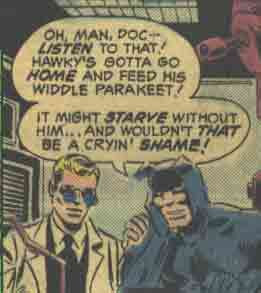
Wildcat responds to his friend's agitated state with "Aw, shuddup, Greenie...Mid-Nite's got work ta do!" A gentleman, this one. Technobabble ensues as Mid-Nite & the Star-Spangled Kid explain how they're trying to keep Fate alive and Power Girl wonders why an ankh appears on a computer monitor. This gets them talking about how Fate originated in Egypt and Lantern decides to visit Egypt in the slim hope of somehow finding something to save Fate's life. Hawkman, the team leader, agrees to this and mentions he has something else to handle. To which Wildcat moans, "Oh, man, Doc -- listen to that! Hawky's gotta go home and feed his widdle parakeet! It might starve without him...and wouldn't that be a cryin' shame!" So, thus far Wildcat has established himself as the team's resident sarcastic whiner. Keep it up Wildcat, you need something to compensate for being more useless to the team than the blind man (Mid-Nite), don't you? Although I came to love the Justice Society over the years, I've never liked Wildcat and now that I've returned to this issue, I can see why; with just two lines of dialogue so far, Wildcat has managed to offer no reassurance, planning or intelligent thought, instead choosing to mock the rest of the team for taking action in the midst of a crisis. Wildcat was an internet troll before there was an internet to troll. I resisted an obvious Miraclo-Viagra joke here, so I think we all win.

The Flash & Hourman arrive, bringing our super hero count up to nine; however, we won't be seeing Mid-Nite, Fate or the Star-Spangled Kid again, and after a brief catch up, Flash takes off with Lantern to Egypt, so despite the large cast Conway and/or Levitz are doing a fine job of telling a story so clear a child could (and did) follow it. Hawkman nominates Hourman for monitor duty with Power Girl, whom the former hasn't met until now. This prompts Hawkman to note Hourman is "still young enough to appreciate her." I don't know when it was decided Hourman was married and had a grown-up son, but I do know his son debuted just a decade later and was within a few years of Power Girl's age. In retrospect, Hawkman is a bit of a creep for suggesting Hourman might enjoy a cradle-robbing affair. Come to think of it, Hawkman is also supposed to be married with a grown-up son by this time...I'm over-thinking this. All right, you Marvel-loving swine, are you HAPPY? We're givin' you those interpersonal dynamics you seem to like, all right?

Hawkman decides to check in on said wife, Shiera. She's better known as Hawkgirl in the comics, but doesn't appear in costume for this story, which again keeps the amount of costumes on display under control. I have to say, I do appreciate this - Mid-Nite is here to be a doctor, not a super hero, so he's out of costume; Fate is a patient, not a super hero, no costume; Hawkgirl is a damsel in distress, not a super hero, no costume; all the characters dressed as super heroes are actually going to behave like super heroes (possible exemption for Wildcat). We cut briefly to Wildcat, Hourman & Power Girl on monitor duty as Wildcat utters his third line, this time telling Power Girl she'd "better not hog all the action" the next time they get into a fight (Wildcat is a normal man who dresses like a cat, period; Power Girl has all the powers of Superman; who do you think contributes more to a fight?). Power Girl observes she just saved the city. Hourman, voicing my thoughts, says "isn't it enough that the job got done?" Wildcat: poster boy of the insecure male ego. Meanwhile, I'm starting to figure out why Hourman became one of my favourite heroes...

Someone called Dr. Arthur Kliburn goes poking through some artifacts, only to be killed by a monstrous creation called Xanadu. I'm Charles Foster Kane!
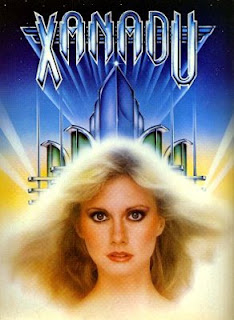
Sorry, that's Zanadu. He's been...KliBURNED! Am I right? Please don't hit me.

Shiera shows ups (Kliburn was poking through the Hawk family's artifacts) and Zanadu captures her, teleporting away. Hawkman arrives too late and sends out a distress call to the Justice Society. Hold him Hourman, I'll make it look like an accident.

Perhaps this is a good moment to bring up Power Girl. Much has been made of the anecdote that Wally Wood - one of the greats at drawing voluptuous female bodies - intentionally expanded Power Girl's chest size for a lark. The problem is, fandom became too conscious of what Wood was doing and it became the number one thing Power Girl was about. Not that "Supergirl on Labour Day" was a brilliant concept on its own, but now that the fans who grew up on these stories are the ones making the decisions in modern DC comics, we've gone from the rather reasonably-proportioned chest Wood drew (above) to catastrophes like this: I lost my costume in an explosion! Lucky thing it was a clean explosive that didn't leave shrapnel, smoke or burns!

But that's what happens when comic book characters are run by the fans - they become parodies of themselves, sketched out by a single defining trait or story and not allowed to deviate from fandom's perception of their character (see also: Hank Pym the wife-beater, Tony Stark the drunk, Hourman the druggie, Arsenal the druggie and Green Arrow the red Commie Pinko Liberal Batman wannabe). Wood's Power Girl may have been subversive for its time, but what does the above image tell you about today's comic book culture? Rhetorical question, don't answer.

Anyway, Hawkman's signal is also received by our very special guest star, whom Wood introduces to the story with genuine class: Wait, the store room is only used for costume changes?

Even in these early days of comic book reading, I knew enough to recognize the silhouette. Oh boy, now things were gonna get good!

We cut away to Egypt where a purple robed man tries to barter for a potion, but refuses to trade his horse. Knowing that the Green Lantern & Flash were headed to Egypt (and that Lantern wore a purple cape), I confusedly thought this robed man was Green Lantern (perhaps I thought Flash had become a horse?). In retrospect, this is probably the Shining Knight. Anyway, that's as far as the subplot goes. Well, it was ten years where we didn't have to see his ugly puss, so I'm thinking...yes.

So, the Justice Society have gathered to hear their leader complain "what good is a Justice Society if it can't protect its own members?" As usual, Wildcat has a pearl of wisdom to offer, glaring at Power Girl as he notes "how crummy things have gotten since ya let the kids in." Power Girl is sometimes characterized as short-tempered, but I have to say...she clearly has plenty of willpower to keep from swatting Wildcat into the next county. All I want is my fair share!

Anyway, up until now Wildcat has been the least reasonable person in the room. So, time for Power Girl to get torqued off! Superman arrives and by now it had become clear to me that this Superman was older than the one I knew (note the white hair at his temples); this was fine by me, since, like so many kids, I thought of Superman as "Superdad." Power Girl, appropriately, reacts to "Superdad" by behaving like a spoiled teenager, demanding she be given her turn in the spotlight. Superman seems more confused by her than anything, noting he hasn't stopped her from being a super hero up until then (although apparently he didn't want her to join the Justice Society) and he hasn't come to interfere, he simply wants to help in this crisis. Frankly, in a single page Superman shows more support for Power Girl than the entire Justice Society; I guess she's just hyper-sensitive when it comes to family. Time to hire a night watchman, JSA.

Hawkman angrily puts on his best Reed Richards face and reminds everyone that his wife is in mortal danger (Face front true believers! The Merry DC Marching Society wants you!) and they depart to find Hawkgirl, leaving Hourman on monitor duty on the grounds that... well, he's clearly too intelligent and competent for this mission and wouldn't be anywhere near as much a hindrance as the non-powered belly-aching Sourpuss or the squabbling Kryptonian cousins. ...And if I ever get an ongoing title of my own then you'd better believe it's a lock for at least 40 issues.

So, Zanadu is in Tokyo, talking to Hawkgirl in funny dialogue balloons to remind you that he's a baddie. Superman & Power Girl launch into battle with some more of their patented bickering, so Zanadu defeats them by encasing them within lava. CALLED IT!

Hawkman & Wildcat are on the ground, looking at all the people Zanadu has rendered unconscious with his powers. Suddenly, Wildcat hears some music and attacks Hawkman, declaring himself a member of the Injustice Gang!

True confession: in retrospect, Wildcat is probably under the mental control of the Fiddler, a member of the Injustice Gang and likely source of the music Wildcat heard. However, when I read this as a child, not knowing who the Fiddler or Injustice Gang were and having witnessed Wildcat's behaviour across the length and breadth of All-Star Comics#62 I believed he had been evil all along and for some reason the team hadn't realized what his sarcastic put-downs and complaints really meant. Again I wondered why Hourman was left on monitor duty.

I have only one other issue of the 1970s All-Star Comics revival in my collection and it's the last issue, nowhere close to matching up with #62. I still don't know a lot of the details surrounding the attack on Dr. Fate, Zanadu, the Shining Knight or the Injustice Gang plots, but none of that bothered me as a child. I grasped that Zanadu was evil (he murdered a man! and took Hawkman's wife hostage!) and the Justice Society were good. I grasped that Power Girl meant well, but was a little brash. I grasped that this Superman was older than the other versions I had seen, but was essentially the same man. I guess my only misstep was believing Wildcat was the team's traitor. In retrospect, I see that Conway and/or Levitz were trying to write Wildcat as the team's Thing (with Power Girl as the Human Torch), giving him a gutter-level dialect and lots to complain about. The thing is, Wildcat is an old man in a kitty suit, whereas the Thing is the super-strong backbone of the Fantastic Four; the Fantastic Four can't do without the Thing, but one feels the Justice Society would function much more smoothly without the whiny old man who has no powers.

Looking back on this comic book now, what I appreciate the most is the Wally Wood artwork; Superman's silhouetted entrance and other inventive page layouts (like the Zanadu page above) really liven up the story.

I still have a lot of fondness for the Justice Society and their related books; within a year of reading this comic I found my first issue of All-Star Squadron and it did a lot to fuel my growing interest in super heroes and their histories. I was particularly taken with the Justice Society's Green Lantern; there's something about the red, green & purple colour combination that shouldn't work, and yet it does; maybe the blond hair ties it all together. Hourman and Dr. Mid-Nite would become fast favourites while Wildcat...well, to me he'll always be Sourpuss.

I know. Shut up.

Wildcat fans... and I assume you must exist, you can't have all died post-1950... you like this character... why?