Thursday, October 13, 2011

Yesterday I began following Cerebus

There was a time when I knew of Dave Sim's Cerebus as "one of those artsy-fartsy comic books only those Comics Journal-types read." Then I connected to the internet during the age when the series was "derided by all, especially those Comics Journal-types."

Strangely, I became a fan of Dave Sim's work through his post-Cerebus output, which certainly isn't discussed in as much volume or detail as any of his 300 Cerebus issues. I bought his 2008 graphic novel Judenhass, quite enjoyed it and soon became an infrequent follower of his book glamourpuss which started at about the same time. Recently, I began buying up the Cerebus Archive, where he discusses his attempts to break into the comic book market and the many mistakes he made as a young cartoonist; I've found the latter series to be so fascinating as a portrait of the rim of 1970s comic book culture that it suddenly struck me...why don't I read that Cerebus book which is ultimately responsible for all of these other projects?

Even though I've been attempting for years to better educate myself in the world of comics (having been a super hero-only type for far too long), Cerebus carries a lot of baggge based on the cursory information I've learned at internet columns and blogs over the last 13 years. I understand that the latter years of Cerebus become a soapbox for Sim's editorializing, but...being that I enjoy Judenhass, glamourpuss and Cerebus Archive, clearly I already enjoy his editorializing. Therefore, my decision is to start working my way through Cerebus one volume at a time until I decide I've had enough (or run out of volumes).

In fact, one of the amazing things about Cerebus is that I can easily obtain the entire series - I think every shop in town carries a set. It caused me to reflect that outside of Dave Sim and Stan Sakai, just about any highly-regarded independent comic book creator's output from the 70s & 80s is nigh-difficult to acquire. Thanks to the shifting interests of audiences, self-destructed publishers, dead creators and retired creators, you won't find many indie hits of times past on your local comic store's shelves. Heck, even a bigwig like Scott McCloud hasn't kept his colour issues of Zot! in-print.

I'm barely into the first volume of Cerebus and so far I'm enjoying it. Already I've seen a remarkable evolution in Sim's style. Early issues of Cerebus play out as something of a Conan parody, which is interesting because in Cerebus Archive Sim expresses how he had little interest in Conan, yet the parody itself is so gentle he could have run the material in Marvel's Savage Sword of Conan with only minor alterations (that the protagonist is a talking aardvark is sometimes the only "funny" part of this "funny animal" book).

Thus far the Elrod character (Elric by way of Senator Claghorn) has been a fun, broad addition to the series and in general the series' dialogue is playful and diverting, helping to steer the stories out of familiar tropes by having characters respond to outrageous situations in a realistic, comedic manner.

Cerebus: I'm reading it.

Thursday, October 6, 2011

Unearthed: All-Star Squadron#48

Last time in Unearthed I looked at All-Star Comics#62 and briefly discussed how it began my interest in comics history, Earth-2 and Hourman. Appropriately, I'm continuing this theme with All-Star Squadron#48 (1985), which I first read shortly after All-Star Comics#62.

Just like All-Star Comics#62, this book appeared without explanation. One summer while visiting my grandfather, it turned up in his house. It was suggested my cousins James & Andrew had left the comic behind during an earlier visit, but it's origins weren't definite.

Checking the cover, we have the Shining Knight pit against Dr. Fate, Robotman & Firebrand while a caption helpfully informs us "The Shining Knight is BACK! Only this time he's on the OTHER SIDE!" Another blurb reads "Camelot 1942!" which turns out to be the title of the story inside. Finally, a blurb promises us "Special Guest Star Blackhawk." Following up on some ideas Colin Smith has been considering, this cover brings up a few things:

  1. With the exception of Hourman, Winston Churchill and our surprise villain, all the major players of this comic are presented on the cover.
  2. Further, the cover sets out the problem: the Shining Knight has turned against the heroes (just like Wildcat on the cover of the previous Unearthed).
  3. The caption explaining the problem is probably necessary; without it, the Shining Knight might as well be a contestant on the Dating Game choosing his match.
  4. The Blackhawk blurb was actually exciting to me - I had exactly one issue of Blackhawk back then and it was always thrilling to realize I was up to speed with the story (since I had no idea who the Shining Knight, Robotman or Firebrand were; I did wonder if Robotman was connected to the more famous Robotman).
  5. Do note that for this comic, Dr. Fate is wearing the half-mask version of his helmet. I think it was originally introduced in the 1940s to give artists a wider range of expressions for the character or perhaps to make him look more like other conventional super heroes; of course, comics being what they are, we were eventually treated to an explanation about him trying to overcome the possibly-sinister machinations of his patron wizard Nabu by exposing his mouth. Let me tell you, those comic books have serious Daddy issues.

A banner atop the opening splash page gives us an introduction to the series concept: "1942 - a world at war! And against the forces of Axis darkness, the mightiest heroes of Earth-Two have banded together, under direct orders of the President, as the All-Star Squadron." This was the 1985 equivalent of today's recap pages; many comics had to explain their concepts within two lines of text because back then you could actually sell your pages as advertising space. It's true! Even so, two lines aren't enough to explain what Earth-2 might be...or about World War II, in case you didn't learn it at school...or which country's President they're referring to, I suppose. Note that the All-Star Squadron's name is derived from All-Star Comics.

Creator credits go to writer Roy Thomas, fan turned writer; Mike Harris, listed as "guest penciler" and not a name I'm familiar with; and inker Vince Colletta, infamous amongst fandom for erasing Jack Kirby's pencil lines to save time and thus possibly the least-liked inker in comics history. That's no reflection on Colletta's prowess as an inker, simply his notoriety.

We open on the Shining Knight riding his flying horse Winged Victory (a pretty good name for a WW2-era horse...but isn't it from Camelot?). The Knight investigates a crumbling castle and finds a silent knight (not the Silent Knight; he turned up in a later issue of All-Star Squadron because...I digress). The Shining Knight attacks the interloper and is startled to find his liege King Arthur behind the helmet. He lowers his guard, overjoyed to see his lord and master, but "King Arthur" knocks him out with a sock to the jaw.

Over the Atlantic Ocean on page six, Firebrand, Robotman, Hourman & Dr. Fate are mid-flight to London. During the flight, Firebrand uses her flame powers to perform some spot-welding on Robotman, who's trying to improve his rockets and armor plating. It seems British PM Winston Churchill requested the All-Star Squadron's aid, although Hourman notes Dr. Fate is the only one asked for by name. Even though Hourman does possess super powers (for an hour at a time), we'll see throughout this issue that he feels unequal amongst his peers; as I stated in my last Unearthed, Hourman was an early favourite of mine and it's mostly due to this issue - I really emphasized with characters who felt a little out of sorts. Come to think of it, I don't believe I ever read an issue of All-Star Squadron where Hourman was the key hero who saved the day, but I recall several where he was stuck on the sidelines just trying to stay alive and keep his confidence up.

Anyway, the All-Stars' plane arrives in London just in time for the Battle of Britain. The Blackhawks join the fight and Hourman starts to gush about them, having heard what great pilots they're supposed to be (we both like the Blackhawks? Hourman and I were separated at birth). As Hourman's powers don't include flight, he's stuck aboard the plane while the other three bail out to engage in aerial combat against the Germans.

So, while the other three All-Stars can fly, Robotman soon discovers those last-minute modifications he made to his body on the plane really should have been tested first; his jets can't manage the new weight from his added armor and he begins to plummet out of the sky. The following four panel sequence is worth examining:

In just four panels with a fixed "camera" (no close-ups), we go from: 1) Robotman in peril; 2) Robotman's humorously desperate attempt at a solution; 3) Robotman's seeming doom; 4) Robotman triumphant. Take particular note of Robotman's face, which isn't a particularly emotive one, yet his open jaw in panel one demonstrates his terror and his wide grin in panel four delivers his sense of accomplishment. I'm not saying Mike Harris & Vince Colletta were a two-headed Alex Toth, but in an age where blank-faced photorealistic models recite the farmer's almanac to each other, it's nice to find a super hero comic with peril, emotion, humour and triumph in just four panels, no matter where you have to look to seek it.

There's also a nice moment during the fight where Firebrand hopes the pilots whose planes she just wrecked manage to save themselves via parachute. It's becoming increasingly accepted for super heroes to kill faceless "lackeys," especially in stories set during World War II, so it's refreshing to see the opposite attitude expressed - she even notes how she used to be all right with killing soldiers, but at some point had an epiphany.

There's also an interesting moment where Dr. Fate smashes through a German plane and Hourman compares him to Superman. Honestly, given the sort of power Dr. Fate displayed back then and that as a member of the Justice Society he was a public figure, it would have been neat to see people favourably refer to Superman as "a regular Dr. Fate!"

With the skirmish over, the All-Stars meet the Blackhawks; Blackhawk himself aside, the others just fade into the background (excepting the ostentatious garb of Chop-Chop). Winston Churchill arrives and ushers Blackhawk and the All-Stars into a meeting (the rest of the Blackhawks depart, lest they clutter up the story) and Winnie explains how the Shining Knight went to explore the site where Camelot once stood, based on reports of strange happenings. The Shining Knight hasn't reported back to Churchill (and he's supposed to be Churchill's bodyguard!), so it's up to the All-Stars (and Blackhawk) to investigate.

As the heroes fly to their ally's last known location (Hourman riding aboard Blackhawk's plane) a bit of exposition creeps out: Fate isn't as powerful as he used to be, but can sense something mystical; Robotman, however, is picking up something unusual as well; Firebrand is a little distracted by the Shining Knight's peril, having earlier held an attraction to him. To their surprise, the trail leads to a very well-kept castle, staffed with knights, King Arthur and Merlin the Magician.

Without speaking a word, Merlin attacks Firebrand & Robotman, but Dr. Fate gets physical with the sordid sorcerer and knocks him apart - "Merlin" is nothing more than a robot. Ah, then King Arthur must be as well, you'd suppose? Not quite. "Arthur" removes his mask to reveal himself as...

Wotan? Not that I'd ever heard of Wotan before, but he dumps a lot of exposition in that panel to bring first-time readers up to speed. Suffice to say, he's one of Fate's personal enemies, although the exact nature of the threat he poses isn't made clear. Anyway, whatever danger Wotan himself poses is beside the point when he can simply make the Shining Knight fight in his stead:

And so, once again we end a story with a couple of Earth-2 heroes taken out of the fight and another placed under the control of a villain and forced to attack his comrade.

I still haven't read All-Star Squadron#49. Somehow resolving cliffhangers doesn't seem that important when you're a child, you accept that you're going to be in the middle of the story just about all the time - you learn to enjoy the middle, find entertainment in the unit of story you're presented with. I did, however, become a big fan of the All-Star Squadron and did my best to collect it at second-hand stores over the years (I never saw a copy on the news stand, which was the only place I could buy new comics until '88). Sadly, All-Star Squadron was just about to hit Crisis on Infinite Earths when this issue came out and the elimination of Earth-2 was, understandably, a blow the series couldn't recover from.

If there's one thing I remember about this comic from my first reading to now (other than the cover), it's the panel of the Shining Knight crying when he thinks he's been reunited with King Arthur:

Perhaps it's because I hadn't seen a hero cry before. Again, kudos to Harris & Colletta for the emotion on display. There are some places where details are lacking, notably backgrounds; there's no way for me know, but I can assume Colletta has a lot to do with the sparse details.

It was fun for me to be exposed to characters like Firebrand & Robotman, heroes who clearly had backstories behind them but whom I hadn't so much as heard of before; to this day, those two aren't the type to get action figures or animated programs. Dr. Fate won me over with the visual of his action figure so I was excited to see him in action during this issue (as opposed to being hospitalized in All-Star Comics#62). Hourman continued to grow on me as I saw him as little more than a normal person in extraordinary circumstances. I feel it's a pity that Hourman has become defined by his Miraclo powers over the last couple decades because I rather like the All-Star Squadron depiction of him as the least-impressive man in the room.

Following this story is a three page portfolio by Mike Clark of Dr. Mid-Nite, Wonder Woman & Green Lantern. The Mid-Nite pin-up really struck me at the time:

Looking at it now, I have some problems with Mid-Nite's body posture and Hooty (the owl)'s proportions, but back in 1985 I was seriously awestruck by this image. I hadn't seen Mid-Nite in costume before (he was in civilian garb in All-Star Comics#62) and I thought the grim, shadowy depiction of him perched on the tree branch was just about the coolest thing I'd ever seen. I know that many comic book fans develop an early love for Batman the shadowy coolness he's supposed to project, yet Batman hadn't made an impression on me (I didn't come around to Batman until the mid 90s when I began regularly watching his animated series). Mid-Nite was my Batman. To this day, he and Hourman remain my pet favourites of the "Earth-2" heroes.

Also of note: on the letters page there's a very small advertisement for Roy Thomas' other Earth-2 series of the time, Infinity Inc.:

You can just barely recognize the signature of Toddy Mac himself; not that I was ever a tremendous fan of McFarlane, but this would have been my first exposure to his art. Little did anyone in 1985 guess he'd become a revolutionary force in the industry, stand as the most successful creator in the business, spend his money on balls, become mired in shameful litigation and end up in bankruptcy. 'Tis a tangled web.

Sunday, October 2, 2011

You are listening to me speak

Or, you could be.

I presented a talk on Angola at my church (Holy Trinity Anglican, Calgary) this morning; thanks to the quick-footed Rob Petkau, it's already available for download at the church website on the download page. Hop on over and give it a listen, yeah?

I've listened to the first few minutes and I think once you get over the terrifying sound of my voice, you may enjoy it.

Monday, September 26, 2011

I see Slave Labor is in the news...

Comic book publisher Slave Labor Graphics (SLG) recently announced they would no longer be publishing comic books in their traditional format, instead selling electronic copies or bound trade paperbacks/graphic novels.

It's certainly sad news for fans of indepedent comic books as that already-small market is drying up even further. I know I enjoy reading something other than super hero stories and movie pitches, which is the alternative SLG offered.

I began reading SLG with Jim Rugg's hilarious Street Angel, which enjoyed only six issues despite massive acclaim on the internet. Shortly after Street Angel's end, SLG began publishing James Turner's Rex Libris, which offered a similar sense of humour which was right in my wheelhouse; it wasn't until Rex finished its 13 issue run that I began to have concerns about SLG - Turner's follow-up book, Warlord of Io, printed only one issue thanks to the comic book marketplace's indifference to its existence. Io became an electronic comic book, then a trade paperback, but the trade was the only place to get the entire story - a little frustrating for fans like me, who were trying to collect it as it came out (and so wound up with anywhere from 2-3 copies of the installments in separate formats).

Sadly, SLG doesn't seem to be making waves in the electronic format - evidently their best-selling ecomic has sold only 200 copies! I've tried to support other SLG books, but independent comics are, by their nature, against the grain. Comic fans complain about how homogenous Marvel/DC/Archie content can be, but it at least locks in an audience who are willing to sample multiple titles - that is, if you can sell Avengers to a reader, you might induce him to try Herc, Deadpool or X-23.

So, despite my goodwill toward SLG and a concerted effort at buying SLG material, I haven't gone far beyond Rugg & Turner's works - I read a decent trade called Midnight Sun and tried to collect Captain Blood: Odyssey (I still don't know if I have all the issues which were published) and the Royal Historian of Oz (the last issue was cancelled but made available electronically; I'm still smarting over the Io matter, but I'll get to it eventually).

I wish SLG well and hope they hang in there, but retreating from the single issue format makes it even less likely that I'll be paying attention to their publications - it means I'll have to go browse their less-than-ideal online store, when I much prefer getting my comic books from a shop.

Tuesday, September 20, 2011

Unearthed: All-Star Comics#62

What makes a comic book stand out in your memory? If you, like me, read hundreds (or thousands) of comics books each year, how can any particular single issue make its mark? I recently posted about the titles I'm currently reading and hinted at how difficult it is to remain a fan when I'm taking in so much content that I've begun to detect repetition from one comic to another and nothing will kill your love for the comics medium faster than perceiving most of what you consume as dross.

It's in that spirit that I'm looking back on one of the first comic books I ever read (it ranks somewhere within my first 100 reads) to remind myself where my love of the medium came from. Recently, I've really taken to the blogging styles of Colin Smith and his blog Too Busy Thinking About Comics; I appreciate how carefully Colin considers comic books of the past and present, so I'm going to make a similar attempt at pondering All-Star Comics#62. Wildcat IS Strangler Lewis!

I don't know how All-Star Comics#62 (published 1976) found its way into my family's house; it seemed to simply appear one day in the family room. None of my siblings ever took it away to their room (as we normally kept our own comics separated), so we evidently believed it was "family" property. I believe it first appeared in the house the same weekend we had held a rummage sale at the church and it's my belief that my father bought it as a present and I missed the announcement. The comic was about 10 years old when it appeared in our house and it was missing its front cover; I don't know what ultimately became of it, but I'm composing this post using a copy I bought from Mile High Comics (it didn't cost me much, but I would've actually sprung for a coverless copy if Mile High had one to offer).

So while I didn't have the cover originally, I do want to consider it ever-so-briefly. It's very busy, isn't it? "The Justice Society of America in All-Star Comics With the Super Squad!" The amount of copy on this cover tells you this was published in a post-Stan Lee world. The cover also gives away this issue's special guest star and the last page's surprise reveal (so I'm glad I didn't have the cover growing up; let's have a few surprises, yes?).

The issue is credited to writers Gerry Conway & Paul Levitz (Conway was apparently on his way out) and artists Keith Giffen & Wally Wood. This is well before Giffen developed his signature style; it's not even Giffen in faux-Kirby as in his 70s Defenders work; I see a lot of Wood in these pages, but little of Giffen. Not that creator names meant anything to me growing up; I knew the name Stan Lee because it appeared as a stylized signature with the word "presents" at the top of each Marvel Comics title page (also, he narrated Spider-Man & Hulk's Saturday morning cartoons). Outside of Stan Lee, I couldn't have told you the names of any comic book creators (not until John Byrne began drawing Superman).

I don't think Crisis on Infinite Earths had transpired when I read this book. That series was predicated on the notion that multiple Earths were too confusing to new readers (or possibly that multiple Earths were much too non-Marvel in concept, why not be more like Marvel?), but I don't recall ever being confused by it; I had already met the Justice Society of America in an issue of Justice League of America (#219), but I recall that story kept away from the idea of alternate Earth counterparts - like, I grokked that there were two Earths, each with a Flash, but the two Flashes were distinctly different characters. But now I risk getting ahead of myself... All Star Super Squad? Pick a name and stick to it already!

Let's start with the splash page; since the aforementioned family copy was coverless, this page really stands out in my memory. Here, we're introduced to seven super heroes; only three are going to stick through the issue. At the far left, Dr. Mid-Nite can be seen in his civilian guise; I had no clue he was supposed to be a super hero. Next to him is Wildcat, about whom... more in a moment. The Star-Spangled Kid is hooked up to some contraption and is thus indisposed for the rest of the issue. Hawkman, Green Lantern & Power Girl complete the circle around the apparatus which contains Dr. Fate. Green Lantern is helpfully carrying Fate's helmet, enabling me to recognize Fate as a child (I knew of Fate & Hawkman thanks to the Super Powers action figures). Green Lantern is upset because someone called Vulcan nearly killed Fate and Lantern blames himself because there's no angst like super hero angst. Yeah, they call me the heart and soul of the Justice Society.
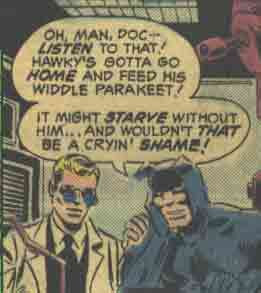
Wildcat responds to his friend's agitated state with "Aw, shuddup, Greenie...Mid-Nite's got work ta do!" A gentleman, this one. Technobabble ensues as Mid-Nite & the Star-Spangled Kid explain how they're trying to keep Fate alive and Power Girl wonders why an ankh appears on a computer monitor. This gets them talking about how Fate originated in Egypt and Lantern decides to visit Egypt in the slim hope of somehow finding something to save Fate's life. Hawkman, the team leader, agrees to this and mentions he has something else to handle. To which Wildcat moans, "Oh, man, Doc -- listen to that! Hawky's gotta go home and feed his widdle parakeet! It might starve without him...and wouldn't that be a cryin' shame!" So, thus far Wildcat has established himself as the team's resident sarcastic whiner. Keep it up Wildcat, you need something to compensate for being more useless to the team than the blind man (Mid-Nite), don't you? Although I came to love the Justice Society over the years, I've never liked Wildcat and now that I've returned to this issue, I can see why; with just two lines of dialogue so far, Wildcat has managed to offer no reassurance, planning or intelligent thought, instead choosing to mock the rest of the team for taking action in the midst of a crisis. Wildcat was an internet troll before there was an internet to troll. I resisted an obvious Miraclo-Viagra joke here, so I think we all win.

The Flash & Hourman arrive, bringing our super hero count up to nine; however, we won't be seeing Mid-Nite, Fate or the Star-Spangled Kid again, and after a brief catch up, Flash takes off with Lantern to Egypt, so despite the large cast Conway and/or Levitz are doing a fine job of telling a story so clear a child could (and did) follow it. Hawkman nominates Hourman for monitor duty with Power Girl, whom the former hasn't met until now. This prompts Hawkman to note Hourman is "still young enough to appreciate her." I don't know when it was decided Hourman was married and had a grown-up son, but I do know his son debuted just a decade later and was within a few years of Power Girl's age. In retrospect, Hawkman is a bit of a creep for suggesting Hourman might enjoy a cradle-robbing affair. Come to think of it, Hawkman is also supposed to be married with a grown-up son by this time...I'm over-thinking this. All right, you Marvel-loving swine, are you HAPPY? We're givin' you those interpersonal dynamics you seem to like, all right?

Hawkman decides to check in on said wife, Shiera. She's better known as Hawkgirl in the comics, but doesn't appear in costume for this story, which again keeps the amount of costumes on display under control. I have to say, I do appreciate this - Mid-Nite is here to be a doctor, not a super hero, so he's out of costume; Fate is a patient, not a super hero, no costume; Hawkgirl is a damsel in distress, not a super hero, no costume; all the characters dressed as super heroes are actually going to behave like super heroes (possible exemption for Wildcat). We cut briefly to Wildcat, Hourman & Power Girl on monitor duty as Wildcat utters his third line, this time telling Power Girl she'd "better not hog all the action" the next time they get into a fight (Wildcat is a normal man who dresses like a cat, period; Power Girl has all the powers of Superman; who do you think contributes more to a fight?). Power Girl observes she just saved the city. Hourman, voicing my thoughts, says "isn't it enough that the job got done?" Wildcat: poster boy of the insecure male ego. Meanwhile, I'm starting to figure out why Hourman became one of my favourite heroes...

Someone called Dr. Arthur Kliburn goes poking through some artifacts, only to be killed by a monstrous creation called Xanadu. I'm Charles Foster Kane!
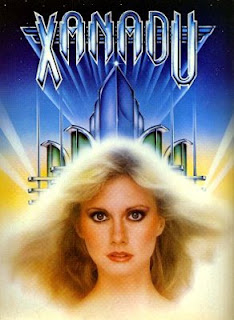
Sorry, that's Zanadu. He's been...KliBURNED! Am I right? Please don't hit me.

Shiera shows ups (Kliburn was poking through the Hawk family's artifacts) and Zanadu captures her, teleporting away. Hawkman arrives too late and sends out a distress call to the Justice Society. Hold him Hourman, I'll make it look like an accident.

Perhaps this is a good moment to bring up Power Girl. Much has been made of the anecdote that Wally Wood - one of the greats at drawing voluptuous female bodies - intentionally expanded Power Girl's chest size for a lark. The problem is, fandom became too conscious of what Wood was doing and it became the number one thing Power Girl was about. Not that "Supergirl on Labour Day" was a brilliant concept on its own, but now that the fans who grew up on these stories are the ones making the decisions in modern DC comics, we've gone from the rather reasonably-proportioned chest Wood drew (above) to catastrophes like this: I lost my costume in an explosion! Lucky thing it was a clean explosive that didn't leave shrapnel, smoke or burns!

But that's what happens when comic book characters are run by the fans - they become parodies of themselves, sketched out by a single defining trait or story and not allowed to deviate from fandom's perception of their character (see also: Hank Pym the wife-beater, Tony Stark the drunk, Hourman the druggie, Arsenal the druggie and Green Arrow the red Commie Pinko Liberal Batman wannabe). Wood's Power Girl may have been subversive for its time, but what does the above image tell you about today's comic book culture? Rhetorical question, don't answer.

Anyway, Hawkman's signal is also received by our very special guest star, whom Wood introduces to the story with genuine class: Wait, the store room is only used for costume changes?

Even in these early days of comic book reading, I knew enough to recognize the silhouette. Oh boy, now things were gonna get good!

We cut away to Egypt where a purple robed man tries to barter for a potion, but refuses to trade his horse. Knowing that the Green Lantern & Flash were headed to Egypt (and that Lantern wore a purple cape), I confusedly thought this robed man was Green Lantern (perhaps I thought Flash had become a horse?). In retrospect, this is probably the Shining Knight. Anyway, that's as far as the subplot goes. Well, it was ten years where we didn't have to see his ugly puss, so I'm thinking...yes.

So, the Justice Society have gathered to hear their leader complain "what good is a Justice Society if it can't protect its own members?" As usual, Wildcat has a pearl of wisdom to offer, glaring at Power Girl as he notes "how crummy things have gotten since ya let the kids in." Power Girl is sometimes characterized as short-tempered, but I have to say...she clearly has plenty of willpower to keep from swatting Wildcat into the next county. All I want is my fair share!

Anyway, up until now Wildcat has been the least reasonable person in the room. So, time for Power Girl to get torqued off! Superman arrives and by now it had become clear to me that this Superman was older than the one I knew (note the white hair at his temples); this was fine by me, since, like so many kids, I thought of Superman as "Superdad." Power Girl, appropriately, reacts to "Superdad" by behaving like a spoiled teenager, demanding she be given her turn in the spotlight. Superman seems more confused by her than anything, noting he hasn't stopped her from being a super hero up until then (although apparently he didn't want her to join the Justice Society) and he hasn't come to interfere, he simply wants to help in this crisis. Frankly, in a single page Superman shows more support for Power Girl than the entire Justice Society; I guess she's just hyper-sensitive when it comes to family. Time to hire a night watchman, JSA.

Hawkman angrily puts on his best Reed Richards face and reminds everyone that his wife is in mortal danger (Face front true believers! The Merry DC Marching Society wants you!) and they depart to find Hawkgirl, leaving Hourman on monitor duty on the grounds that... well, he's clearly too intelligent and competent for this mission and wouldn't be anywhere near as much a hindrance as the non-powered belly-aching Sourpuss or the squabbling Kryptonian cousins. ...And if I ever get an ongoing title of my own then you'd better believe it's a lock for at least 40 issues.

So, Zanadu is in Tokyo, talking to Hawkgirl in funny dialogue balloons to remind you that he's a baddie. Superman & Power Girl launch into battle with some more of their patented bickering, so Zanadu defeats them by encasing them within lava. CALLED IT!

Hawkman & Wildcat are on the ground, looking at all the people Zanadu has rendered unconscious with his powers. Suddenly, Wildcat hears some music and attacks Hawkman, declaring himself a member of the Injustice Gang!

True confession: in retrospect, Wildcat is probably under the mental control of the Fiddler, a member of the Injustice Gang and likely source of the music Wildcat heard. However, when I read this as a child, not knowing who the Fiddler or Injustice Gang were and having witnessed Wildcat's behaviour across the length and breadth of All-Star Comics#62 I believed he had been evil all along and for some reason the team hadn't realized what his sarcastic put-downs and complaints really meant. Again I wondered why Hourman was left on monitor duty.

I have only one other issue of the 1970s All-Star Comics revival in my collection and it's the last issue, nowhere close to matching up with #62. I still don't know a lot of the details surrounding the attack on Dr. Fate, Zanadu, the Shining Knight or the Injustice Gang plots, but none of that bothered me as a child. I grasped that Zanadu was evil (he murdered a man! and took Hawkman's wife hostage!) and the Justice Society were good. I grasped that Power Girl meant well, but was a little brash. I grasped that this Superman was older than the other versions I had seen, but was essentially the same man. I guess my only misstep was believing Wildcat was the team's traitor. In retrospect, I see that Conway and/or Levitz were trying to write Wildcat as the team's Thing (with Power Girl as the Human Torch), giving him a gutter-level dialect and lots to complain about. The thing is, Wildcat is an old man in a kitty suit, whereas the Thing is the super-strong backbone of the Fantastic Four; the Fantastic Four can't do without the Thing, but one feels the Justice Society would function much more smoothly without the whiny old man who has no powers.

Looking back on this comic book now, what I appreciate the most is the Wally Wood artwork; Superman's silhouetted entrance and other inventive page layouts (like the Zanadu page above) really liven up the story.

I still have a lot of fondness for the Justice Society and their related books; within a year of reading this comic I found my first issue of All-Star Squadron and it did a lot to fuel my growing interest in super heroes and their histories. I was particularly taken with the Justice Society's Green Lantern; there's something about the red, green & purple colour combination that shouldn't work, and yet it does; maybe the blond hair ties it all together. Hourman and Dr. Mid-Nite would become fast favourites while Wildcat...well, to me he'll always be Sourpuss.

I know. Shut up.

Wildcat fans... and I assume you must exist, you can't have all died post-1950... you like this character... why?

Wednesday, September 14, 2011

State of comics: today

"If your hobby becomes your profession, find a new hobby." - Mark Gruenwald

I always feared there was some truth to the above quote. For most of the last decade I've been toiling on projects about Marvel Comics and it gradually transforms my hobby into a chore. It becomes increasingly difficult to approach a Marvel comic - or any other super hero comic - with a genuine fascination in the narrative of the fictional universe. I can't bring myself to care about where any particular stories are going...but I can still appreciate the craft displayed in a good story which is well told.

Since I have this problem with super hero universes, it's really up to the non-super hero books to keep me going as a hobbyist; today I brought home five new comics, all them from non-super hero publishers (five different publishers too). It's been a very long time since I've shared my thoughts on what I'm buying, so why not join me? Thank you.

Sergio Aragones Funnies#3 contains various features by Aragones, some of them the type of gag cartoons he publishes in Mad, but there's also an interesting story about a feature Aragones spent some time sketching up, only to learn it had all been done before. My favourite part of this series, however, are Sergio's autobiographical features; he's lived an interesting life and this issue's tale relates how he met a famous cellist. Sergio's biographical stories are always modest and genuinely human; I hope Funnies carries on for years to come.

Of all the stories which have been told about Lewis Carroll's fiction, Snarked#0 is definitely one of them. It's written/drawn by Roger Langridge, whom I only discovered as of his Muppet Show comics, but he's quickly becoming a favourite writer of mine. Because this is a $1 preview issue, Snarked doesn't do much more than establish the setting and cast of characters for the series, which stars the Walrus and the Carpenter of Through the Looking Glass fame; the Walrus is a grifter and the Carpenter is his dim-witted accomplice. Looks good!

G.I. Joe: A Real American Hero#170 continues Larry Hama's return to the franchise he made world famous. This issue carries on various running stories about the return of Sneak Peek (and what he's been up to), Roadblock, Lady Jaye & Flint preparing for a mission (allowing Hama an opportunity to discuss handgun maintenance), Cobra Commander walking through his wax museum (a wonderfully absurd moment typical of Hama), Jane defeating Crystal Ball & Firefly (Crystal Ball being reduced to a joke) and Storm Shadow learning how his family's ninja clan wound up with a Russian branch. So far this series has been heavy on plot and I don't think it's broken out the sort of excellence I know Hama is capable of...but the plot, characters, quips and insights into the armed forces are enough to entertain me until then. Interestingly, Hama's G.I. Joe was the only book in this stack with a writer-artist collaborating team.

I picked up Stan Sakai's Usagi Yojimbo#140 despite having missed #139 while in Angola; #139 was the first of a two-part tale, so I've spoiled myself on the resolution. This story bring back Inspector Ishida, a brilliant detective who's one of the series' best recurring characters. Part of why I enjoy seeing Ishida appear in a Usagi tale is that he's uncommonly good at catching criminals. After years and years of reading super hero comics where criminals are almost never punished, it's cathartic to read the opposite now and then.

Digging back a little ways, I bought Dave Sim's Cerebus Archive#5 as I've been gradually working my way through the series. I've never read Cerebus or much else of Sim's work, but reading Sim's account of how he attempted to break into the comic book industry in the 1970s is utterly fascinating. Of particular note in this issue is a 5-page story Sim had to fluff up to 8 pages and it did suffer from the transition. There's a lot to learn in Cerebus Archive, even if only as a series of cautionary tales.

Over all, this was a good day for me as a comic book hobbyist - humour, action, adventure, biography and a history lesson; while books such as these are being published, I shouldn't want for lack of entertainment!

Tuesday, September 13, 2011

Angolan blackouts

Apologies for the considerable lack of blogging; having spent most of August in Angola, I've been mulling, musing and meandering over how to express my experiences in a way people can appreciate.

The problem I have with trying to summarize my Angolan trip is that while explaining how I perceived Angola, I might in haste fall into making generalizations about the people or country. Generalizations are my number one pet peeve (ask anyone who knows me); so, I'm going to record one observation I made which I think (hope) will give you a small view of how Angola differs from Canada.

Almost every day in Angola, there would be at least one blackout. The anticipation amongst locals was for the power to go off in the evening, usually between six and seven PM. It would happen suddenly and without warning; if I was at work on a computer which didn't have its own generator, I would lose whatever I was working on. Although the power usually went out in the evening, it sometimes went out during the day as well, all because of work being done on the nearby dam, work (and thus blackouts) expected to continue for two more years. The places I frequented had fuel-burning generators to supplement the city power, so power could always be restored; power outages primarily delayed people, more than inconvenienced.

The way locals dealt with the power outages typlified the attitude I often saw toward problems - what you might call a "laid back" attitude. It seemed to me that over time, people had become accustomed to the frequent power losses so they didn't grow upset at it. I couldn't imagine my co-workers in Calgary managing multiple power losses per day every day anywhere near as gracefully. I certainly don't like giving up control over my situation, but after a few days of power outages I had to let go of my expectations and work as hard as I could with the resources I had while I had them.

So, that was life in Angola - problems were always arising, some of them anticipated and familiar. It seemed to me that people made the most of their situation; when a blackout hit on my last full day in Angola, just as I was preparing to teach my students how to perform some work which we needed light to accomplish, we were left counting the minutes until I would have to leave, hoping the generator would kick in before my time expired. And yet, I didn't feel the stress of the situation because it turned out to be an opportunity to chat with my students and learn more about them. They quizzed me about my reactions to Angola, they asked about Calgary (and after hearing how much snowfall we receive suggested I remain in Angola) and I made some careful remarks about politics. I'm grateful to that last blackout because it enhanced my rapport to the students. That's one way I think of Angola and I brought back a candlestick to remind me.