Wednesday, November 30, 2016

Alfred Hitchcock (and Suspense) Presents

Good evening.

At the same time I began to discover the works of Alfred Hitchcock - first through Nick at Nite reruns of Alfred Hitchcock Presents, then his films - I was becoming interested in old-time radio; perhaps my favourite program was Suspense.

There is an interesting connection between Hitchcock and Suspense. You see, the original 1940 pilot for the series was produced by Hitchcock, starred repeated Hitchcock performer Herbert Marshall and adapted The Lodger, which had been earlier adapted by Hitchcock to film.

When the radio series materialized in 1942, Hitchcock was no longer attached. The series aired until 1962 and did frequently utilize actors who appeared in Hitchcock films - most notably Herbert Marshall, who appeared more often than any other lead performer, as well as film/TV Hitchcock performers Joseph Cotten, Peter Lorre and Claude Rains plus film stars Anne Baxter, William Bendix, Raymond Burr, Madeleine Carroll, Robert Cummings, Henry Fonda, Joan Fontaine, Cary Grant, Edmund Gwenn, Charles Laughton, Ray Milland, Robert Montgomery, Gregory Peck and James Stewart.

Hitchcock prepared a second radio pilot in 1948, this time titled Once Upon a Midnight and adapting the tale "Malice Aforethought." Notably, both this and his earlier "The Lodger" failed to completely adapt their source material within a half hour, leaving the stories incomplete; Hitchcock and his staff had yet to learn how to tell a satisfying tale in a half-hour.

Hitchcock was not exactly absent from radio - virtually all of his 1940s Hollywood films had radio adaptations (notably not on Suspense - when Suspense adapted The Thirty-Nine Steps they used the original John Buchan novel, not Hitchcock's film version). But finally, from 1955-1965 (mostly running concurrently with Suspense and its television counterpart) Hitchcock found the right format for his type of mystery anthology series: television. Alfred Hitchcock Presents had arrived and wrote the rulebook on what a half-hour dramatic anthology would be like.

But, as evidence that even without Hitchcock, Suspense ran on very similar lines, there are many instances of Hitchcock adapting stories to his program which had earlier been heard on Suspense! Initially, many of these stories appeared under different titles for television, perhaps to disguise them from overly-familiar viewers. Let's take a look at all those stories, shall we?

Alfred Hitchcock Presents debuted with the story "Revenge" which had appeared as "Nightmare" on Suspense in 1949. However, I think we can all agree on the television version's superiority. Both tales concern a man seeking revenge on the person who assaulted his wife, but the radio version inserts an "it was all a dream" cop-out ending, the sort of trifle Hitchcock would avoid (and mock) on his program.

The Hitchcock episode "The Older Sister" is actually reworked from a Suspense episode which aired the previous year: "Goodbye, Miss Lizzie Borden." Both concern the legend of Lizzie Borden and a suggested solution for the murders of Lizzie's parents.

Another early Hitchcock episode "Our Cook's a Treasure" comes from Dorothy L. Sayers' "Suspicion," which appeared twice on Suspense, featuring the tale of a man who thinks his new cook might be a notorious poisoner.

Alexander Woollcott's legend of "The Vanishing Lady" appeared on Hitchcock as "Into Thin Air." It had earlier appeared under its original title on the sibling programs Escape and Suspense, telling the tale of a young woman whose mother disappears and everyone involved claiming to have never seen her mother before.

"Alibi Me" is a rather restrained crime tale about a murderer who's desperate to find an alibi after he murders his worst enemy. Suspense performed the play twice.

Ray Bradbury's "And So Died Riabouchinska" debuted as an episode of Suspense before it ever saw print on its own. Claude Rains did a masterful job in the Alfred Hitchcock Presents adaptation. You may recall I blogged about this story last October.

Alfred Hitchcock loved John Collier's twisted little tales, such as "Back for Christmas," which told of a professor who murdered his wife and buried her in his cellar. Suspense performed the story twice (Peter Lorre in the 1943 version) with their sibling Escape producing it once.

Ambrose Bierce's weird tale of the Civil War notably appeared on both Alfred Hitchcock Presents and The Twilight Zone, but earlier than that was likewise heard on Suspense and Escape. The Escape version is the best, to my thinking.

"The Black Curtain" was a crime novel by Cornell Woolrich dealing with a man suffering from memory lapses (a, shall we say, common situation in Woolrich stories). Suspense made a great adaptation with Cary Grant in 1943 & 1944, but each adaptation has taken significant liberties with the source material, mostly keeping nothing but the gimmick of a man discovering he's lost a year of his life.

Hitchcock and Suspense both clearly liked Woolrich because they likewise each adapted another of Woolrich's tales, "Momentum."

John Collier's "Wet Saturday" is just the kind of cold-blooded and frightfully British tale Hitchcock swooned for. Suspense adapted it themselves several times, once in an hour-long program with "August Heat."

Another of Collier's tales, "De Mortuis" was heard on Suspense but you'll find this drama (starring Charles Laughton) is considerably more complicated than the Hitchcock version; both tell of a man discovering his wife is unfaithful after his friends wrongly assume him to be a murderer.

Hitchcock rather loved Thomas Burke's "The Hands of Mr. Ottermole" (he directed the television adaptation) and it was heard on Suspense with Claude Rains as the detective investigating a series of murders and a journalist who always seems to be about.

The Alfred Hitchcock Presents version of Cornell Woolrich's "Post Mortem" is all right but I truly do not care for the Suspense version, which has a strangely light-hearted tone and a grating performance by Agnes Moorehead.

A.M. Burrage's "The Waxwork" is a masterpiece among the genre of "horror in a wax museum" fiction and I think both Alfred Hitchcock Presents and Suspense did right by the tale, though the 1956 radio version is perhaps a bit more unnerving than Hitchcock's.

"Banquo's Chair" was frequently adapted on Suspense and tells a simple-enough tale of a detective trying to frighten a man into confessing a murder. Hitchcock's television version was fine as well.

And while that's all for Suspense, why don't we keep going? There's only a few other Alfred Hitchcock Presents tales which have radio counterparts. First up: Escape and "Poison." Hitchcock loved Roald Dahl's fiction but he didn't quite do right by the tale on television, tacking on a climax which changed the purpose of Dahl's tale in a very unfortunate way; stick with Escape version, it's quite faithful and William Conrad gives the performance of a lifetime.

On the other hand, Hitchcock adapted Ray Bradbury's "Marionettes, Inc." rather faithfully into "Design for Loving," while the X Minus One radio adaptation added a very different conclusion. I also blogged about this Bradbury tale back in October.

Finally, "The Creeper" is a classic tale of a maniac on the loose while a woman is at home alone, not certain whom to trust. In addition to television, you can hear it adapted on the Molle Mystery Theater

Thank you for indulging this digression into one man's fascination with Alfred Hitchcock and old-time radio. I'll be back to blog with you another evening; good night.

Wednesday, November 16, 2016

"Why do I have to choose?" Out of This World #20 and #25 review

Yet another Steve Ditko comic book has been produced via a Kickstarter project run by his long-time editor Robin Snyder. You may recall last time (as I posted here) Snyder printed one reprint comic and one of Ditko's newer Snyder books. This time there is again one reprint book, Out of This World #20 and the all-new #25.

Out of This World #20 reprints various Ditko comics which are either in public domain or are Ditko's own property. From Ditko's Charlton days are reprinted "A World Where I Was King" and "From All Our Darkrooms." Also featured are "In Due Time" from Strange Avenging Tales #1 (which I covered on my blog here), a tale from Mort Todd's Monsters Attack called "Face It" and a pair of rare 1970s stories published in Questar magazine featuring the Destruction Agent and Star.

Taken together, Out of This World #20 is a splendid look at Ditko across the years - Ditko of the 50s, 70s & 90s. Strangely, it's the stories from the 50s & 90s in which I find him most disciplined, telling stories with identifiable plots and characters. The 70s tales from Questar are full of weird energy but aren't paced quite right. In both tales it feels like compilations of an adventure comic strip where you only have the Sunday pages and none of the weekday pages which were building up to that Sunday's events. Throughout the tales I found myself wondering - "wait, what are they after?" and "hold on, who's this guy? is this the first I'm seeing of him?"

It's a shame that comic book culture doesn't often speak about Ditko's contemporary work, for here we have #25, containing six brand-new comic stories by Ditko. At this point, it feels as though fandom has rendered its judgment upon Ditko's self-published works and are no longer interested in talking about it - only Ditko fans in the echo chamber are still examining his work. To some extent, I am likewise guilty of this for I struggle to have anything new to say about his present-days works. Very often, his stories are screeds about objectivism which I find unpersuasive and while I frequently admire his penciling, I'm repeatedly irritated by the rough scripting and half-formed characterizations.

...And so I feel much the same about #25. Many of the pages look unfinished and unprofessional. One begins to feel as though they are not so much supporting new Steve Ditko comics as new Steve Ditko sketchbooks. The new tales include recent creations of his such as the Madman, the Cape and the Hero. The tales include "Either or" and "Choices" which are both objectivist tracts, while "Action-Reaction" is another instance of Ditko musing upon his relationship with his fanbase.

I'm not old enough to have witnessed how the Ditko/fandom dynamic has played out over the decades but at this point, Ditko seems quite frustrated by people like... well, me - people who presume to criticize objectivism without having read Ayn Rand (per his editorial "Philosophy vs. No- or Anti-Philosophy." In "Action-Reaction" Ditko depicts the arrival of a new Steve Ditko comic and the consumer's choice to either accept or reject it; when the exchange of money and product occurs, the purchaser then flies into an angry rage, tearing the comic apart. At this stage, rage is not what I've seen from today's Ditko followers - very few people talk about Ditko at all and most of the reactions I see in the fanzine Ditkomania are very forgiving (and tend to be objectivists like him). I'm afraid the days of people becoming enraged by Ditko's comics are long past - that may very well be how fans reacted in the late 60s when he first began telling his Mr. A stories, but today... Ditko's known for his Spider-Man & Doctor Strange work which predates Mr. A; the rest is being steadily ignored.

Taken as a whole, I am glad Mr. Ditko is still telling stories and has a modest audience who are interested in his work. He's a living legend and regardless of how much I enjoy his recent stories, I am happy to continue supporting his publications.

Tuesday, November 15, 2016

"...And here are the people forced to argue about 90s alternative rock for the rest of eternity!" Cerebus in Hell #0 review

It has been 12 years since Dave Sim's Cerebus ran to its long-awaited conclusion. Sim has not exactly been idle since then, what with his book glamourpuss and his plan to publish The Strange Death of Alex Raymond. His recent alliance with IDW has even led to Sim drawing the occasional cover or short story for them. Unfortunately, a hand injury in 2015 has seemingly left Sim unable to draw, his future as an artist very much in jeopardy. Cerebus to the rescue!

Cerebus in Hell #0 is the introduction of Sim's new Cerebus product, picking up where the 300 issue series left off. If you read all the way to the end, you may recall it concluded with the abominable aardvark dying of old age and going to Hell. Ergo, Cerebus in Hell is set in Hell. Makes sense, don't it?

As Sim is unable to draw, the solution to creating a new Dave Sim comic book has been to run everything through Photoshop; Cerebus is represented by a rather limited number of stock poses which Sim drew years earlier. The other characters and backgrounds are derived from Gustave Dore's woodcut-illustrated edition of Inferno by Dante Alighieri (the cover is a painting by Hieronymus Bosch) with Sim's computer-generated lettering providing the script.

It's appropriate to be revisiting Cerebus at this time as the character's 40th anniversary is upon us, so this could be construed as a happy accident (for we readers, not so much Sim's right hand). The form of punishment Cerebus endures in Hell is also quite delicious: having previously been the protagonist of the longest graphic novel in the English language, Cerebus is now the protagonist of a 4-panel gag strip not unlike other funny animals such as Garfield or Heathcliff. In way, Sim has gone back to his roots what with his 1970s strip The Beavers.

The jokes found within are a mixed bag, but as there's a new gang on each page there are enough laughs to justify buying the rest of Cerebus in Hell as it appears. Beyond that, the skill with which this book was created is fun in and of itself. Seeing how Sim can repurpose a character from Inferno into DC Comics' Spectre is quite neat. This comic is pretty much destined to appeal only to a small niche audience but as one within that niche, I am quite pleased.

Monday, November 14, 2016

"He talks to animals? Isn't that a bit much?" The Phantom: Danger in the Forbidden City review

Honest question: who is the greatest Phantom artist? Is there one? Could it be the original artist, Ray Moore? To my largely-uneducated eyes I can't say there is a Phantom artist who gets my blood pumping... or least, I formerly didn't.

Enter Sal Velluto.

In 2014 writer Peter David and artist Sal Velluto produced a wonderful six-issue mini-series about the Phantom, now collected by Hermes Press as The Phantom: Danger in the Forbidden City. Velluto seemed to be a rising star in the 1990s and by 2000 caught my eye during his tenure with Christopher Priest on the Black Panther. Velluto has never attained the level of super-stardom I feel his work merits; he comes from a storytelling style super hero comics championed in the heyday of John Buscema and Neal Adams which is, I suppose, no longer in fashion. But to anyone who enjoyed his previous work this is perhaps the best Sal Velluto ever - in the sense he didn't only pencil this art but ink it as well.

Writer Peter David can usually be counted on for a light touch and a burlap sack full of puns. This time, David has written a period adventure (not certain when - 1940ish?) so his usual pop culture humour is nixed. His breezy dialogue works well in this high adventure style. David has some history with the Ghost Who walks, having first written him back in 1988; on assumes he has some fondness for the character to have visited him on both sides of his lengthy career.

The story is full of the most popular Phantom lore; the Phantom's top enemies the Singh Brotherhood are at hand, as is the Sky Band's leader the Baroness (whom I spoke of yesterday). The Phantom's wife Diana is present and treated as an important part of his fighting force. The deepest cut, however, is the presence of Jimmy Wells, Diana's old flame. As explained in accompanying text pieces, creator Lee Falk originally introduced Jimmy to the comic strip as a potential secret identity of the Phantom's but ultimately decided against it. Building on that, David reveals Jimmy is, in his own way, a jungle hero much like the Phantom. Jimmy was raised by wild elephants and can speak to animals - something which the Phantom balks at and is obviously a commentary on Tarzan and his many imitators (though David resists the urge to explain the joke).

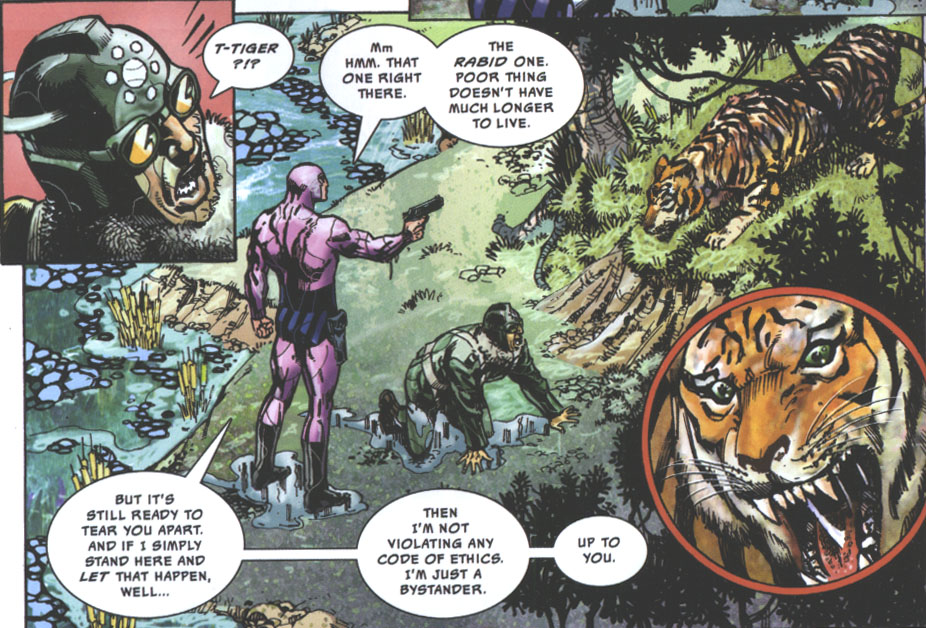
At one point the Phantom is attacked in the jungle by a tiger; if David were free to indulge in his pop culture references no doubt the hero would have uttered, "A tiger? In Africa?" It feels like a strange lapse on the creative side but perhaps it was intentionally anachronistic - that David & Velluto weren't trying to depict the real Africa but the Africa of boys' adventure novels, comic strips and film serials of the past. When the Phantom finally does journey to a hidden African kingdom the reader is treated to the same kind of fashions & tools Velluto drew in Black Panther so many years ago. Perhaps the best sequence is when the Phantom leaps out of an airplane for a mid-air fight with an attacking biplane. It's pure pulp and wonderful. If you're curious about the Phantom, snap this book up - it's quite good fun.

Sunday, November 13, 2016

"If you were a man, I'd be at your throat, regardless of that gun." The Phantom vs. the Sky Maidens review

It seems as though the Phantom has never quite received his dues; sure, he's been appearing in comic strips since 1936; he's been in-and-out of comic books during those years, had a number of prose novels, a couple of animated programs, a live action film serial and movie starring Billy Zane! The Phantom has so permeated our culture that some warriors in Papua New Guinea use the Phantom's face to decorate their shields.

And yet, much of the Phantom's fans live below the equator - Australia, South Africa, South America - and we in North America don't quite care for him. That's a pity as he's a historically important figure in popular culture, being perhaps the first example of a super hero. He doesn't quite obtain that honor despite being a character from comics who wears a mask and full body skintight costume, a double identity including a secret identity, and even belongs to a line of succeeding costumed heroes (something which was not initially a big part of comics but certainly is today). He's usually omitted from the title of first super hero because he appeared first in comic strips (comic books are considered the native domain of super heroes) and he didn't have super powers (even though he's as much a super hero as Batman). Basically, Superman casts a deeper shadow than the Phantom.

I've never been too well-versed in the Phantom's world (though I had many great times in my childhood playing with my Defenders of the Earth Phantom figure). Perhaps I'm least knowledgeable about his very comic strip origins - I've never a newspaper which carried the Phantom. To that end, I recently obtained a copy of The Phantom vs. the Sky Maidens, a collection of Phantom newspaper strips from a very popular 1936-37 Phantom storyline by author Lee Falk and artist Ray Moore (said story is also called "The Sky Band" by some).

In this early tale, a rogue squadron of aircrafts are robbing airmail planes (similar to the "Air Pirates" story from Mickey Mouse's comic strip, but not as inventive). The authorities still don't know what to make of the Phantom and believe him be to the leader of the Sky Band. To clear his name, the Ghost Who Walks must thwart the Sky Band single-handed (okay, his pet Devil helps). To the Phantom's surprise, the Sky Band are made up of women and led by the beautiful Baroness. In the midst of this, the growing attraction between the Phantom and Diana Palmer is furthered (later in the strip series they are wed).

If you've seen the Billy Zane Phantom movie then you'll no doubt realize as I did that the film's band of lady air pirates led by Catherine Zeta-Jones were adapted from this storyarc. It's a great fast-paced adventure - not as clever or lushly rendered as Crane's Captain Easy or Caniff's Terry, but Moore's panels are filled with deep shadows and a sense of weird menace.

Let's resume talking about the Phantom tomorrow!

Saturday, November 12, 2016

"'Post-war' extends forever." Shin Godzilla review

Shin Godzilla, directed by Hideaki Anno and Shinji Higuchi, is the latest Godzilla motion picture from Japan; it's been appearing in North America in a limited release with subtitles; to my surprise, my home city in dusty ol' Calgary hosted the film in a pair of theatres. I'm not a tremendous fan of Godzilla, but I like the concept when it's executed well - that is, when the film either has a philosophy worth hearing or is tremendous fun to watch. My most learned friend on Godzilla, Craig, told me this was a Godzilla film worth seeing. And so it was.

Like the US versions of Godzilla, this is a complete reboot - nothing, not even the 1954 original, is left in-continuity for the purposes of this film. Thus, we have Godzilla making his first-ever appearance in modern-day Japan with absolutely no one prepared to deal with the likes of he; but this is not only a throwback in the sense of people seeing Godzilla for the first time, it also hearkens back to the spirit of the 1954 film. In 1954, Godzilla, King of the Monsters examined how post-atomic bomb Japan was dealing with its own anxieties about war and atomic destruction. Shin Godzilla does likewise (there are many references to the atomic bombs and "scrap and build") but is chiefly concerned with Japan's 2011 earthquake/nuclear disaster.

I had my doubts about this film due to Hideaki Anno's past as creator of Neon Genesis Evangelion. Yes, it is considered one of the greatest anime programs of all time, but the ending of that series truly soured me on Evangelion (and frankly, much of anime). There are touches in this film which seem much like his vision: the international rivalry over monster killing, Godzilla "evolving" and firing a grid of laser beams from his back, discussions about Godzilla as a "god" ...also: Shinji = Shin Godzilla!!! Wake up, sheeple! Atomic breath can't melt steel beams!

My doubts quickly vanished; this film drew me in immediately with its method of storytelling - lots of dialogue, lots of sets, scene upon scene. The dialogue is at times delivered so quickly (the director was inspired by The Social Network) that the subtitles would nearly cover the screen! This is one non-English film where I think a good dub would be welcome for the sake of those who don't read & absorb too quickly. At any rate, you need to pay attention during this film and the dark environs of a film theater are well suited to it; it's less likely you'll check your e-mail at the cinema (though the person next to me checked a message).

The film is very skeptical of leaders, be they interlopers from the U.S.A. who are convinced they can solve Japan's problems, to the bureaucracy in Japan's own government. At the times the film is much like a political farce. In one instance, the word is given to engage Godzilla; word travels through all the appropriate ranks until the helicopters mobilize and surround Godzilla; now the pilots ask for authorization to fire; word travels back up through the ranks until it reaches the Prime Minister, who authorizes firing; when bullets prove ineffective, the pilots ask for authorization to use missiles; one more, the message is relayed through channels until the Prime Minister agrees! It's very unlike a typical Godzilla picture.

Outside from leaders, the film also has it in for unimaginative thinkers; the ultimate solution to defeating Godzilla is very creative (and involves hitting Godzilla in, appropriately, the shin), but all other avenues are proven to be ignorant, thoughtless or ill-considered. There is a particular anxiety about using nuclear weapons against Godzilla which all of us who have seen Godzilla films know won't work, and are thus better able to see the use of nuclear weaons as a mistake - something which the franchise has always been on-point about.

Shin Godzilla has probably wrapped up its North American trip by now, but I encourage you to seek it out on video when it arrives.

Friday, November 11, 2016

Unearthed: The Destructor #4

Welcome back! Once again I have exhumed my infrequent feature "Unearthed," in which I delve into some long-retired piece of comic book history. I am very pleased to once more feature the short-lived Atlas comics hero The Destructor, drawn by Steve Ditko! You may recall I have already featured the first three issues on this blog:

Destructor #1

Destructor #2

Destructor #3

At last, I finally hold a copy of Destructor #4 in my hands, thus completing the series! Let's jump right in!

"Doomsday -- Minus One!" blares the cover once again rendered by Larry Lieber in his best faux-Kirby manner. You will observe the Destructor is still wearing the refined costume from issue #3; you shall also note he apparently now has the ability to fire blasts of energy from his hands. Generic powers for a generic hero!

The story inside was brought to us by new author Gerry Conway (replacing Archie Goodwin), returning artist Steve Ditko and new inker Al Milgrom (replacing Frank Giacoia). We open within a cavern in New Mexico as two men hired by the Combine are hunting for the Destructor. Having hidden above the cavern, the Destructor simply drops upon his two enemies and with his superhuman strength handily defeats them. Just as one of the two men draws his gun, a blast of energy strikes from out of the darkness of the cave, hitting the gunman in the back (fatally?).

And who fired this beam of energy? Before the Destructor stand three superhuman beings whom we'll soon learn are Kronus, the Eye and Sister Siren. The Eye's cyclopean "de-moeleculorize" ray was responsible for hitting the Combine agent and the Outcasts now demand the Destructor remain where he is; our hero refuses and the Eye fires a beam at him which misses. "You may have a wacko eye-blast -- but I've got the powers of a beast -- and that makes me the winner!"

Kronus quickly orders Sister Siren to sing her "dream song -- before we have to commit violence!" Evidently firing a destructive ray of energy does not constitute violence in Kronus' mind, but it seems to suggest a pacifist streak amongst these Outcasts. Sister Siren emits a "melodius, luring strain" which causes the Destructor to black out.

The Destructor awakens in an advanced facility with the Outcasts facing him, his mask removed. They all begin calling him Jay Hunter, although he doesn't stop to wonder how they learned his secret identity. Sister Siren begins talking about their world and how their parents "abandoned the culture from which you sprang," but Jay has no interest in gabbing: "as far as I'm concerned, you can take your junior 'Star Trek' set and shove it!" Jay seems unusually high-strung this issue as he socks the Eye one in the face and threatens to do likewise to Sister Siren. Kronus appears and suggests the Destructor is one of them - an Outcast - but Jay takes exception to this.

You may possibly have noticed Kronus' powers haven't been established up until now; we now see he has the power to send people into other dimensions and briefly deposits Jay in one to teach him a lesson. This alien dimension is fully of frightening beasts and has no clear directional axis - yes, it is clearly a Steve Ditko creation. When Jay is brought back to the Outcasts' base he decides to be rational and listen to what Kronus has to say.

While taking Jay on a tour of their underground city in a flying vehicle, Kronus explains the Outcasts' parents were people who feared the atomic bomb and built their city to avoid fallout. Because this is a Steve Ditko comic it is tempting to suppose they were Galtian "off the grid" folks, but that would suggest Ditko plotted this comic which I don't believe was the case (then again, maybe Conway was hired strictly for scripting duties; these Outcasts certainly seem very similar to the Misfits created by Ditko's friend and ex-inker-of-Destructor Wally Wood).

Unfortunately for the founders of this city, they were financed by one Abraham E. Caldwell III "and he was evil incarnate." Caldwell insisted on testing an experimental nuclear power plant in the city, which - as the residents' entire motivation was to escape nuclear weapons - did not go over well. Unable to prevent Caldwell, the citizens watched as their children were born as mutants with superhuman powers. When Caldwell returned in 1956 he was beaten to death by an angry mob. Kronus concludes his explanation by revealing all of the Outcasts are telepaths, which is how they learned Jay's name. Hearing all of this, Jay begins to feel they truly are alike, which prompts a sinister reaction from the Outcasts. There is nothing in the script to suggest the Outcasts are anything other than forthright with Jay, but Dikto's art certainly says otherwise. I don't know how Destructor was created but I assume it would have been "Marvel style," so Ditko likely created the pages with very little input from Conway.

Suddenly, an atom bomb is set off ten miles away (this is the unluckiest anti-atomic radiation plot ever). The radiation from the blast bathes Jay and reacts with the serum in his bloodstream, causing his powers to alter even further so that now he can emit destructive blasts of energy. "We may have gained a new soldier for our... army." Kronus remarks with another fiendish Ditko grin. The Outcasts convince the Destructor he should use his powers to destroy the nearby army base where the bomb was tested and Jay sets off with the Eye to do just that. To be continued... never!

The next issue blurb announced "The Man with the Golden Bomb" which sounds like a magnificent Bond mash-up. But this is where the Destructor ends - the plot of him destroying the Combine unresolved and with Jay joining forces with the Outcasts (though it's the sort of plot where one assumes he would eventually discover they had evil intentions).

Conway didn't have time to get into the Destructor's character, what with this issue basically setting up a completely different series and taking its time to introduce the Outcasts. Archie Goodwin had a firm grip on the plotting & characterization in the first three issues, but for whatever reason (editorial? Ditko?) this last issue jettisons much of what made the prior issues work. Ditko remains game, of course and can never be boring. The Outcasts are a bit generic as characters but are fine Ditko designs.

Unfortunately, the Destructor suffered from being too generic; even if the comic book marketplace of the time had been more forgiving to the line of Atlas Comics it would not have made up for Destructor's generic origin, generic powers, generic motivation and generic costume. What the strip most needed was something unusual; Ditko drew unusual characters, true; Goodwin could script unusual villains; but a hero avenging his father's death by wearing a costume and using the powers he received from a fluke experiment is played out on every level. As Jay began as a criminal and would sometimes use his connections to combat the Combine, perhaps it would have been more interesting if Jay were like Serpico, an undercover super hero trying to bring down the gangsters he worked alongside; that would have been different and appropriate to the 70s zeitgeist.

This then is the end of the Destructor. Look for his return when the rights around the Atlas heroes are sorted out and he's (inevitably) snapped up for a quickly-forgottten revival series. My money's on Dynamite, but IDW has fair odds. And then there's Marvel, but... hm... what was I talking about?