The comic book marketplace introduces nearly a hundred new products every week; something always slips under the radar, even the super hero comics from the big two publishers (Marvel & DC). In that spirit, I think it's interesting to look at the non-super hero comics Marvel has published over the last year because I don't believe I've read any reviews of them on the internet. In some ways, it strikes me that a non-super hero Marvel comic has a more difficult time gaining attention than such material found at Boom!, IDW, Dark Horse or Image.
ANITA BLAKE

ADAPTED FROM: The series of novels by Laurell K. Hamilton. Adapted by Jessica Ruffner and Ron Lim.
WHAT IT'S ABOUT: Anita Blake is a professional reanimator (much as the Great Gildersleeve was a water commissioner) who keeps running into vampires in the course of her work, sometimes using her talents to assist the police, but always menaced by the seductive Jean-Claude, who wants to make her his servant.
MY PRIOR EXPERIENCE: I read the first Blake novel Guilty Pleasures when I was a co-writer on the Guilty Pleasures Handbook for Marvel; what can I say, I was young, humble and wanted to see my name on something other than super heroes.
WHAT IT'S LIKE: Anita runs into vampires who posture at her; she postures back; they go their separate ways. The story is firmly in the Daishell Hammett school of detective tales, concerned more with characters' dialogue and suggesting at menace rather than action driving the plot. People in Anita's world are very casual about the supernatural; at one point, a young reanimator Anita is helping to train is attacked by two vampires who bite him; does Anita charge to the rescue, teaching the vampires a lesson in pain? No, she more or less shoos them away and their master scolds them. One cover depicts some vampiric snake creatures which seems promising; the creatures become snakes for only one panel in the story itself and don't actually start a fight. In that Hammett vein, Anita doesn't play detective so much as she's constantly thrown into events beyond her control and triumphs by outliving her enemies. I always feel sorry for the innocent bystanders, though.
As a long-time fan of Ron Lim, there are two ways to consider his art in this series; on the one hand, Lim is aping the style of Brett Booth (Anita Blake's original artist); on the other hand, Lim is working without an inker, making this the purest Lim I'll probably ever see published. I do admit some disappointment with Lim's work in one issue where he depicts Anita having a telephone conversation over the course of a page. Isn't it comics 101 to switch out at least one panel to show us the person on the other end of the conversation? Special props to the colorist, Laura Villari, whose work is all the more vital without an inker present.
DARK TOWER

ADAPTED FROM: The series of novels by Stephen King. Adapted by Peter David, Sean Phillips, Luke Ross and Michael Lark.
WHAT IT'S ABOUT: Roland the gunslinger pursues the mysterious Man in Black across a wasteland of mutants and monsters, confronting supernatural horrors with a western flavour.
MY PRIOR EXPERIENCE: Nil.
WHAT IT'S LIKE: This is genuinely great material which I found easy to slip into despite my lack of familiarity with the Dark Tower novels and comics. I think anyone could drop in on Dark Tower at the start of any story and find their way without difficulty; it's a simple premise and the stories keep moving forward with cracking good dialogue and playful narration.
Richard Isanove's colouring keeps a uniformity to the series, which is no small feat; Sean Phillips, Luke Ross and Michael Lark each have styles of their own, but Isanove could fool you into thinking the series has only one artist. Special props to Luke Ross, whose storytelling skills are utterly magnificent in a way so few comics today are; in the Little Sisters of Eluria#2, he has one page with 21 panels! That issue contains 180 panels total, twice as many as the average comic book! And he does this for artistic effect, using the smaller panels in #2 to increase the sense of claustrophobia and menace, switching in issue #3 to larger panels (92 total) for a flashback sequence. Give this man more work, please!
ENDER'S GAME

ADAPTED FROM: The series of novels by Orson Scott Card. Adapted by Aaron Johnston, Pop Mhan and Giancarlo Caracuzzo.
WHAT IT'S ABOUT: In Ender in Exile and Speaker for the Dead, having committed xenocide against the Formic race, Ender seeks redemption; in the prequel Formic Wars, the early days of Earth's war with the Formics is depicted.
MY PRIOR EXPERIENCE: Nil, although my sister always spoke highly of the novels.
WHAT IT'S LIKE: Again, I came into Ender in Exile with no familiarity with the source material or the comics which had come before, yet I was suddenly drawn in mid-story thanks to sharply-defined characters, fine dialogue and an easy-to-grasp storyline. The Formic Wars were difficult to get into because of the larger cast and different setting, but Speaker for the Dead was much more involving. Kudos to Pop Mhan, whose talents have grown since I last recall seeing his art.
15 LOVE
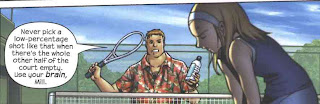
ADAPTED FROM: Marvel Comics' own Millie the Model. Rebranded by Andi Watson and Tommy Ohtsuka.
WHAT IT'S ABOUT: Mill Collins is a struggling young tennis player who takes on a new coach in the hopes of avoiding expulsion from a prestigious academy.
MY PRIOR EXPERIENCE: I've read Millie the Model. Stop judging me! I write handbooks!
WHAT IT'S LIKE: I suppose this occurs in the Marvel Universe, since Millie the Model is Mill's aunt; I doubt making the connection more explicit would have helped this book garner attention, but it's worth noting this is the one comic in the feature bound to turn up in the Official Handbook of the Marvel Universe. It's actually an excellent piece of work! It's clear to see how it was meant to surface around 2002 based on the manga-esque art of Ohtsuka and the lower-case lettering from Russ Wooton; it's also difficult to see it ever finding the teenage girl audience who would most appreciate it. But it's an engaging read, focusing on the dramas of Mill and her coach trying to establish mutual trust. Mill has an adversarial tennis player nemesis from the start of the series, but their big showdown is actually the second-last match of the series - the real drama comes between Mill and her coach during the final match. I've heard tennis comics are popular in Japan and based on 15 Love I can see why.
HALO
ADAPTED FROM: The video game series and Eric Nyland's novel the Fall of Reach. Adapted by Brian Reed and Felix Ruiz.
WHAT IT'S ABOUT: John-117 is a Spartan II super-soldier trained from childhood to put down insurrection on Earth's colony worlds, but when the extraterrestrial Covenant appear, the Spartans' new job is to ensure humanity's survival.
MY PRIOR EXPERIENCE: I'm actually a huge Halo fan, having played all of the first-person shooter games up to the present; I don't read the novels, however.
WHAT IT'S LIKE: Yet another series which I can't judge based on its strengths as an adaptation! However, based on my overall familiarity with the Halo universe, the Fall of Reach comics do a fine job with John-117's personality (not easy to get across because he doesn't emote) and Ruiz, who I didn't think was well-suited to Marvel's super hero comics, does an excellent job with the spaceships, aliens and weapons, keeping consistency with the source material.
JOHN CARTER

ADAPTED FROM: The series of novels by Edgard Rice Burroughs. Adapted by Roger Langridge and Filipe Andrade.
WHAT IT'S ABOUT: John Carter finds himself on the planet Mars, where the indigenous Tharks treat him like a pet; then he discovers there are human-like residents on Mars.
MY PRIOR EXPERIENCE: Nil.
WHAT IT'S LIKE: Andrade is another artist who I'd had some doubts about based on his super hero work, but even though all I've read is the first issue of A Princess of Mars, it's clear his gifts are in science fiction environs. I enjoyed the first issue quite a bit, thanks to some fun dialogue and how the Tharks are portrayed as uninterested in Carter, rather than hostile.
OZ

ADAPTED FROM: The series of novels by L. Frank Baum. Adapted by Eric Shanower and Skottie Young.
WHAT IT'S ABOUT: Various adventures in the magical land of Oz, including the Marvelous Land of Oz, Ozma of Oz and Dorothy and the Wizard in Oz.
MY PRIOR EXPERIENCE: I read most of Baum's Oz work when I was in junior high. I read everything the local libraries had in stock, at any rate.
WHAT IT'S LIKE: These are beautiful comic books! Although I would never have imagined Oz under Young's visuals, his designs are so different from what I'm used to that I look forward to each new character introduction; he did a smashing job with my personal favourite, the Very Hungry Tiger. Fun dialogue, fun stories, fun art...what's not to love?
THE STAND

ADAPTED FROM: The series of novels by Stephen King. Adapted by Roberto Aguirre-Sacasa and Mike Perkins.
WHAT IT'S ABOUT: After a catastrophic plague reduces Earth's population, various survivors gather together to confront the supernatural horror of the Dark Man.
MY PRIOR EXPERIENCE: Nil.
WHAT IT'S LIKE: I've heard a lot of good things about the Stand, but coming in mid-point I have to say, I think I need to have read the novels to appreciate this material. The cast is bloody huge and the stakes aren't quite clear to me. I don't even get a sense of this series depicting a world where 99% of the population is dead - thanks to the largely rural settings, it seems about as densely populated as the real world. I'm glad to see Perkins sticking with this series for consistency's sake, yet I wonder if it'll hurt his recognition amongst comics fandom when he'd been building a pretty good name for himself on Captain America. Ah, but maybe people will be reading the collected editions of the Stand comics for decades to come.
ZOMBIES CHRISTMAS CAROL
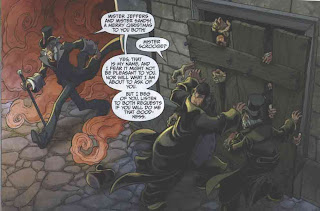
ADAPTED FROM: The novel A Christmas Carol by Charles Dickens. Repurposed by Jim McCann and David Baldeon.
WHAT IT'S ABOUT: As a zombie plague ravages London, Ebenezer Scrooge learns from three spirits how he's been the unwitting carrier of the disease and only he can set the world right.
MY PRIOR EXPERIENCE: I've read A Christmas Carol and experienced various radio/film adaptations.
WHAT IT'S LIKE: I think Pride and Prejudice and Zombies has much to answer for. This book is an odd duck, being a rather faithful adaptation of A Christmas Carol except for how scenes are altered to admit zombies into them. By attempting to adhere to the structure of Dickens' book, it makes for an atypical zombie story...for one thing, the zombies lose!


