Monday, October 24, 2011

I Love Atlas Comics#10: The Man Who Steals Gravestones!

In the spirit of Halloween, I've dug up an old blog feature and jolt it back to life; for the week leading up to the holiday, I'll be writing up new entries in my old "I Love Atlas Comics" series!

Today, let's look at 1953's Adventures into Weird Worlds#14 (reprinted from Crypt of Shadows#5) and Sol Brodsky's story "The Man Who Steals Gravestones!"

He's actually using a modest winch, but when I first saw this splash page years ago I thought the gravestone-nabber had an elaborate removal device.

We open in a cemetery with Josiah Creech, the man who steals gravestones. After loading the old gravestone into his wheelbarrow, then into his truck, Creech brings the stone back to his shop and chisels the names off the slab, then places it in his display window; you see, Josiah is in the business of gravestone sales.

One day an older gentleman purchases a gravestone from Josiah for $100 and Josiah carries the stone to the cemetary himself, intending to plant it lightly in the ground so it will be easier to re-steal. However, once the gravestone is planted the purchaser disappears without having paid Josiah. Josiah wonders what's going on, when suddenly he's pulled through the ground itself!

Josiah finds himself within a coffin beside the man who purchased the gravestone. He believes since Josiah seems to want his gravestone so badly...

Creech already has such a look of death about him (the tight skin on his skull, the sunken eyes), he actually looks less lively than the dead man.

Be back tomorrow for another "I Love Atlas Comics!"

Sunday, October 23, 2011

The perils of reading Michael Kupperman

I'm really getting into Michael Kupperman's work, I enjoy how his comics present absurd situations which characters underplay for humourous effect. As I worked my way through my stack of new comics last week, I began reading Tales Designed to Thrizzle#6:

Tee-hee.

Ha-ha-ha!

Bwa-ha-ha-ha!

Then I picked up a copy of Jay Faerber & Simone Guglielmini's Near Death#2, the new series about a hitman who tries to turn his life around and save lives:

*chuckle*

Ha-ha- wait a minute, that's not funny.

I had to set Near Death#2 down for about 5 minutes then start reading again. It seems that after a little bit of Kupperman, you start seeing jokes everywhere.

Thursday, October 20, 2011

I meant to post this...about two years ago...

I only just stumbled upon an interview at Comixtreme from 2009 where I was sitting next to Riley Rossmo at the Another Dimension signing table as he was being interviewed; because it was being taped, after I interjected one line, I suddenly found myself being asked for my credentials and found the subject matter shifting over to my work. You can read it here.

Looking at it now, I'm surprised at how well I come across; I felt a bit cheap for intruding on Riley's spotlight with what was supposed to be a single off-the-record remark (about Riley's work, no less). I especially love this:

RR: He was buying $20 worth of Force Works and I asked him, “Are you sure?”

MH: It’s research.

RR: I think only half the time, it’s actually research - I think most of them are just guilty pleasures.

Oh, the things I own from years of handbook writing; I had to pay through the nose to get a set of Terry Kavanagh's Marc Spector: Moon Knight.

Wednesday, October 19, 2011

Unearthed: Steve Ditko's Static

Until now, I've been using Unearthed to look back on comic books I read in my youth. Today's example does dip back into 1983, but I didn't acquire my copies until a couple of years ago. The subject is the Static serial which ran in issues #1-3 of Eclipse Monthly.

Eclipse Monthly was an anthology title run by editor/publisher Dean Mullaney and featuring work by notable creators like Doug Wildey, Marshall Rogers and Gene Colan. It had been preceded by Eclipse, a black & white magazine-format series. I collected Eclipse and the first three of Eclipse Monthly because they contained a serialized adaptation of Sax Rohmer's Dope by Trina Robbins. I started thinking about these two series again while I was reading Dave Sim's Cerebus Archive#6, wherein he discussed the mistakes Orb made, noting:

"Changing the format is a bad idea -- going from magazine size to comic book and then back again was just confusing."

And:

"Continued stories don't work in erratically published titles or anthology titles. 5- and 6- page installments are too short to "hook" the average reader. A continued story has to be book-length and anthologized stories have to be self-contained.

I don't know the full story behind Ditko's Static, but one senses editor Mullaney wanted to give Ditko a free hand in developing his own super heroes, a way of setting right the assumed indignity of being scripted by Stan Lee in the 1960s. Static was plotted, scripted, penciled and inked by Ditko, much like his Mr. A. In fact, it is very much like Mr. A...

We meet our cast in Eclipse Monthly#1; they consist of scientist Ed Serch, his assistant Mac Rey and Serch's daughter Fera (unusual names are a trademark of the series). While Rey is testing Serch's new experimental space environmental suit within a special environmental simulator, two men break in and steal the Enego device from Serch, attempting to kill Rey in the process. Instead, Rey's suit absorbs electricity and they soon discover he can use the suit's power to increase his strength.

As Serch, Rey and Fera discuss the theft of the Enego device, the series demonstrates its fatal flaw; Serch recalls how rival doctors Pety, Ems and Rale were all interested in the Enego and he's convinced Ems is behind the theft. Rey, learning quickly how to control his suit's unexpected powers, believes he can pursue the Enego thieves and stop Ems. Fera is upset with Serch and Rey, saying it isn't their responsbility, they should notify the police.

By the fourth page of Static, a lot of speechifying has set in and it's quite deflating. Arguments loop around the same issues again and again but worse, aren't even logical. Serch and Rey's decision to pursue Ems for the missing Enego is based on Serch's belief Ems is the thief. Because Fera is the series' straw (wo)man, she fails to point this out when she argues for contacting the police. I mean, there's been a theft at the laboratory and an attempt on Rey's life. Serch and Rey, how ever responsible they feel, are not qualified to solve crimes. Shouldn't they at least bring the facts to the police, even their suspicions? Serch and Rey act as though their suspicions are both a) correct and b) unpresentable to the authorities, thus justifying vigilante behaviour. Static and Fera follow the criminals in a van, because apparently the thieves didn't have enough time to get out of visual range while Rey was discovering his powers, exhibiting his powers, arguing about using his powers and convincing Fera to help him pursue the criminals. It's weak storytelling.

This isn't the first time in the series a criminal announces hearing "static" while Static sneaks around. It really doesn't work because no one talks like that. An exclamation like "hey, what's that weird static-y noise?" might pass muster, but remarking "I hear static" as though it's something you occasionally notice on the highway draws too much attention to the contrived effort at inserting the hero's name into the villains' mouths.

So, Rey goes into battle as Static to retrieve the Enego, much to Fera's dismay. As it turns out, Dr. Ems didn't steal the Enego, the other two scientists - Dr. Pety and Dr. Rale were behind the theft. Static fights Rale, who dons a nifty-looking suit with giant fists and finally electrocutes Rale by using himself as a conduit through a light socket. Static reclaims the Enego and returns to Fera, who hopes Rey "learned a lesson" from all of this, but he clearly intends to keep being Static (or we'd have no story).

Eclipse Monthly#2 continues the tale as the villain Boron tries to kidnap Dr. Otto Cern, only to accidentally kill him. Serch, Rey and Fera attend Cern's funeral and get into a two-page argument on the matter, with Serch and Rey jumping to the conclusion Cern was murdered and Fera wailing at them to let the police do their jobs. The argument runs through 14 very crowded panels, one so badly mangled that Rey is all but obscured. It was over this panel that editor Dean Mullaney argued with Ditko, ultimately driving him away from Eclipse when Ditko refused to accept Mullaney's criticism.

So, Static investigates Cern's murder and luckily Boron returns to the scene of the crime, enabling Static to defeat him and his master. However, Fera steals the Static costume and refuses to let Rey wear it again.

The third and final Static story run by Eclipse appeared in Eclipse Monthly#3. Here, Dr. Serch is kidnapped by the General to build a super weapon for him and Static has to rescue him, forcing Fera to give the suit back (strangely, this happens off-panel! Fera is seen resisting his demands for the suit, then he's Static again on the following page). Serch becomes most upset at how he agreed to build the weapon for the General, trusting in Static to rescue him; he feels he let himself down by pretending to assist the General.

It seems as though Ditko intended for the arguments between Serch, Rey and Fera to be the core of this series, given how much time he devotes to them. The problem is he runs over the same material every story, the characters unchanging in their viewpoint (although it's suggested in the third story that Serch may be reconsidering allowing Rey to use the Static suit; Rey, a true objectivist, simply notes that's Serch's right). The conflict between Serch, Rey and Fera is one note, played again and again. The series would have been stronger as a whole if Ditko had run part of his screed in each story, rather than the full argument each time. If the argument in the first story had been restricted to "is it right to become a vigilante?" it might have been readable. Instead, that argument is played in each story, along with digressions on personal responsibility, not trusting the authorities and whether power corrupts.

Through it all, I never get a good sense of who Static is. I have a pretty good understanding of Fera from the arguments she loses. Static wins every argument and every fight, taking it with the ease of shopping for groceries. I never felt Static was challenged by anything - he masters his powers, he talks circles around Fera and he beats the bad guys. And so, despite having a fight scene and at least one argument in every story, Static feels like a strip devoid of conflict; the villains and Fera are the only ones being put at risk - the hero is up on a pedestal. Ditko's Spider-Man is one of the all-time greatest super heroes in part because of how the hero would react to failure; Static's seeming inability to fail makes him rather bland.

Ditko eventually self-published the rest of Static. His Static work in Eclipse Monthly is absolutely gorgeous, so far as the artwork is concerned. Unfortunately, the unrelatable characters drag the concept down.

Tuesday, October 18, 2011

The Marvelous Non-Marvels

The comic book marketplace introduces nearly a hundred new products every week; something always slips under the radar, even the super hero comics from the big two publishers (Marvel & DC). In that spirit, I think it's interesting to look at the non-super hero comics Marvel has published over the last year because I don't believe I've read any reviews of them on the internet. In some ways, it strikes me that a non-super hero Marvel comic has a more difficult time gaining attention than such material found at Boom!, IDW, Dark Horse or Image.

ANITA BLAKE
From Anita Blake: Vampire Hunter - Circus of the Damned: the Ingenue#3

ADAPTED FROM: The series of novels by Laurell K. Hamilton. Adapted by Jessica Ruffner and Ron Lim.

WHAT IT'S ABOUT: Anita Blake is a professional reanimator (much as the Great Gildersleeve was a water commissioner) who keeps running into vampires in the course of her work, sometimes using her talents to assist the police, but always menaced by the seductive Jean-Claude, who wants to make her his servant.

MY PRIOR EXPERIENCE: I read the first Blake novel Guilty Pleasures when I was a co-writer on the Guilty Pleasures Handbook for Marvel; what can I say, I was young, humble and wanted to see my name on something other than super heroes.

WHAT IT'S LIKE: Anita runs into vampires who posture at her; she postures back; they go their separate ways. The story is firmly in the Daishell Hammett school of detective tales, concerned more with characters' dialogue and suggesting at menace rather than action driving the plot. People in Anita's world are very casual about the supernatural; at one point, a young reanimator Anita is helping to train is attacked by two vampires who bite him; does Anita charge to the rescue, teaching the vampires a lesson in pain? No, she more or less shoos them away and their master scolds them. One cover depicts some vampiric snake creatures which seems promising; the creatures become snakes for only one panel in the story itself and don't actually start a fight. In that Hammett vein, Anita doesn't play detective so much as she's constantly thrown into events beyond her control and triumphs by outliving her enemies. I always feel sorry for the innocent bystanders, though.

As a long-time fan of Ron Lim, there are two ways to consider his art in this series; on the one hand, Lim is aping the style of Brett Booth (Anita Blake's original artist); on the other hand, Lim is working without an inker, making this the purest Lim I'll probably ever see published. I do admit some disappointment with Lim's work in one issue where he depicts Anita having a telephone conversation over the course of a page. Isn't it comics 101 to switch out at least one panel to show us the person on the other end of the conversation? Special props to the colorist, Laura Villari, whose work is all the more vital without an inker present.

DARK TOWER
From Dark Tower: the Battle of Tull#1

ADAPTED FROM: The series of novels by Stephen King. Adapted by Peter David, Sean Phillips, Luke Ross and Michael Lark.

WHAT IT'S ABOUT: Roland the gunslinger pursues the mysterious Man in Black across a wasteland of mutants and monsters, confronting supernatural horrors with a western flavour.

MY PRIOR EXPERIENCE: Nil.

WHAT IT'S LIKE: This is genuinely great material which I found easy to slip into despite my lack of familiarity with the Dark Tower novels and comics. I think anyone could drop in on Dark Tower at the start of any story and find their way without difficulty; it's a simple premise and the stories keep moving forward with cracking good dialogue and playful narration.

Richard Isanove's colouring keeps a uniformity to the series, which is no small feat; Sean Phillips, Luke Ross and Michael Lark each have styles of their own, but Isanove could fool you into thinking the series has only one artist. Special props to Luke Ross, whose storytelling skills are utterly magnificent in a way so few comics today are; in the Little Sisters of Eluria#2, he has one page with 21 panels! That issue contains 180 panels total, twice as many as the average comic book! And he does this for artistic effect, using the smaller panels in #2 to increase the sense of claustrophobia and menace, switching in issue #3 to larger panels (92 total) for a flashback sequence. Give this man more work, please!

ENDER'S GAME
From Ender in Exile#3

ADAPTED FROM: The series of novels by Orson Scott Card. Adapted by Aaron Johnston, Pop Mhan and Giancarlo Caracuzzo.

WHAT IT'S ABOUT: In Ender in Exile and Speaker for the Dead, having committed xenocide against the Formic race, Ender seeks redemption; in the prequel Formic Wars, the early days of Earth's war with the Formics is depicted.

MY PRIOR EXPERIENCE: Nil, although my sister always spoke highly of the novels.

WHAT IT'S LIKE: Again, I came into Ender in Exile with no familiarity with the source material or the comics which had come before, yet I was suddenly drawn in mid-story thanks to sharply-defined characters, fine dialogue and an easy-to-grasp storyline. The Formic Wars were difficult to get into because of the larger cast and different setting, but Speaker for the Dead was much more involving. Kudos to Pop Mhan, whose talents have grown since I last recall seeing his art.

15 LOVE
From 15 Love#2

ADAPTED FROM: Marvel Comics' own Millie the Model. Rebranded by Andi Watson and Tommy Ohtsuka.

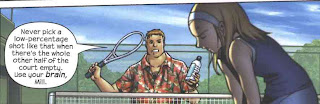
WHAT IT'S ABOUT: Mill Collins is a struggling young tennis player who takes on a new coach in the hopes of avoiding expulsion from a prestigious academy.

MY PRIOR EXPERIENCE: I've read Millie the Model. Stop judging me! I write handbooks!

WHAT IT'S LIKE: I suppose this occurs in the Marvel Universe, since Millie the Model is Mill's aunt; I doubt making the connection more explicit would have helped this book garner attention, but it's worth noting this is the one comic in the feature bound to turn up in the Official Handbook of the Marvel Universe. It's actually an excellent piece of work! It's clear to see how it was meant to surface around 2002 based on the manga-esque art of Ohtsuka and the lower-case lettering from Russ Wooton; it's also difficult to see it ever finding the teenage girl audience who would most appreciate it. But it's an engaging read, focusing on the dramas of Mill and her coach trying to establish mutual trust. Mill has an adversarial tennis player nemesis from the start of the series, but their big showdown is actually the second-last match of the series - the real drama comes between Mill and her coach during the final match. I've heard tennis comics are popular in Japan and based on 15 Love I can see why.

HALO
From Halo: Fall of Reach - Bootcamp#1

ADAPTED FROM: The video game series and Eric Nyland's novel the Fall of Reach. Adapted by Brian Reed and Felix Ruiz.

WHAT IT'S ABOUT: John-117 is a Spartan II super-soldier trained from childhood to put down insurrection on Earth's colony worlds, but when the extraterrestrial Covenant appear, the Spartans' new job is to ensure humanity's survival.

MY PRIOR EXPERIENCE: I'm actually a huge Halo fan, having played all of the first-person shooter games up to the present; I don't read the novels, however.

WHAT IT'S LIKE: Yet another series which I can't judge based on its strengths as an adaptation! However, based on my overall familiarity with the Halo universe, the Fall of Reach comics do a fine job with John-117's personality (not easy to get across because he doesn't emote) and Ruiz, who I didn't think was well-suited to Marvel's super hero comics, does an excellent job with the spaceships, aliens and weapons, keeping consistency with the source material.

JOHN CARTER
From John Carter: A Princess of Mars#1

ADAPTED FROM: The series of novels by Edgard Rice Burroughs. Adapted by Roger Langridge and Filipe Andrade.

WHAT IT'S ABOUT: John Carter finds himself on the planet Mars, where the indigenous Tharks treat him like a pet; then he discovers there are human-like residents on Mars.

MY PRIOR EXPERIENCE: Nil.

WHAT IT'S LIKE: Andrade is another artist who I'd had some doubts about based on his super hero work, but even though all I've read is the first issue of A Princess of Mars, it's clear his gifts are in science fiction environs. I enjoyed the first issue quite a bit, thanks to some fun dialogue and how the Tharks are portrayed as uninterested in Carter, rather than hostile.

OZ
From Ozma of Oz#4

ADAPTED FROM: The series of novels by L. Frank Baum. Adapted by Eric Shanower and Skottie Young.

WHAT IT'S ABOUT: Various adventures in the magical land of Oz, including the Marvelous Land of Oz, Ozma of Oz and Dorothy and the Wizard in Oz.

MY PRIOR EXPERIENCE: I read most of Baum's Oz work when I was in junior high. I read everything the local libraries had in stock, at any rate.

WHAT IT'S LIKE: These are beautiful comic books! Although I would never have imagined Oz under Young's visuals, his designs are so different from what I'm used to that I look forward to each new character introduction; he did a smashing job with my personal favourite, the Very Hungry Tiger. Fun dialogue, fun stories, fun art...what's not to love?

THE STAND
From the Stand: the Night Has Come#1

ADAPTED FROM: The series of novels by Stephen King. Adapted by Roberto Aguirre-Sacasa and Mike Perkins.

WHAT IT'S ABOUT: After a catastrophic plague reduces Earth's population, various survivors gather together to confront the supernatural horror of the Dark Man.

MY PRIOR EXPERIENCE: Nil.

WHAT IT'S LIKE: I've heard a lot of good things about the Stand, but coming in mid-point I have to say, I think I need to have read the novels to appreciate this material. The cast is bloody huge and the stakes aren't quite clear to me. I don't even get a sense of this series depicting a world where 99% of the population is dead - thanks to the largely rural settings, it seems about as densely populated as the real world. I'm glad to see Perkins sticking with this series for consistency's sake, yet I wonder if it'll hurt his recognition amongst comics fandom when he'd been building a pretty good name for himself on Captain America. Ah, but maybe people will be reading the collected editions of the Stand comics for decades to come.

ZOMBIES CHRISTMAS CAROL
From Zombies Christmas Carol#5

ADAPTED FROM: The novel A Christmas Carol by Charles Dickens. Repurposed by Jim McCann and David Baldeon.

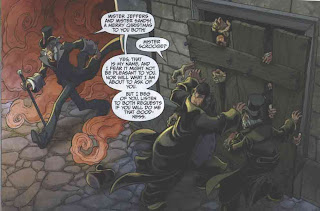
WHAT IT'S ABOUT: As a zombie plague ravages London, Ebenezer Scrooge learns from three spirits how he's been the unwitting carrier of the disease and only he can set the world right.

MY PRIOR EXPERIENCE: I've read A Christmas Carol and experienced various radio/film adaptations.

WHAT IT'S LIKE: I think Pride and Prejudice and Zombies has much to answer for. This book is an odd duck, being a rather faithful adaptation of A Christmas Carol except for how scenes are altered to admit zombies into them. By attempting to adhere to the structure of Dickens' book, it makes for an atypical zombie story...for one thing, the zombies lose!

Monday, October 17, 2011

Star Trek: the Star Trek - but is it Star Trek? A Star Trek review about Star Trek.

I don't believe my friends have ever called me to account for myself for not having seen Marty, Brokeback Mountain or the Hurt Locker. But when certain friends learned I hadn't seen 2009's Star Trek*? Oh mercy, I was called on the carpet. From the aghast faces my friends made, you would think I had confessed to consuming human flesh, not that I hadn't watched some high-grossing sci-fi action epic.

Truth be told, I did turn down an offer to watch the film in theatres with a friend. Later, when a friend suggested it as an option during a group movie night, I vetoed it, receiving some comment. Later still, I had the film only a few paces away from the checkout counter at a video store when I was planning to watch the film accompanied by Rifftrax with a group of friends, until one member of the group suggested we watch the Rifftrax of Twilight: New Moon instead (she had cause to regret this and wound up angrily complaining that we were stuck watching Twilight: New Moon). It's only because Star Trek turned up on Netflix that I finally gave in and watched it.

I avoided the film for a couple of reasons. First, because I used to be a Star Trek fan, but my love for the franchise had been ground down from years of Star Trek: Voyager and Enterprise until I just wanted to put it all behind me. Second, I suspected that Star Trek was best enjoyed by new (or casual) audiences, not an old warhorse like me (similar to how my parents could never adopt Star Trek: the Next Generation as their own).

Having seen the film, my original impressions were justified. It's not for me. I wouldn't call Star Trek a bad movie (no matter how much it overdoes lens flare), it's a pretty good movie on its own terms. The film's real problem is that it isn't willing to stand on its own terms.

Had the film made a clean break from Star Trek lore I could have respected that, but so much screen time is spent inserting references to the previous iteration of Star Trek. It's a problem I've seen before in comic books when super hero universes are supposedly rebooted, yet the creators can't help remarking on what's come before and revisiting familiar plots & characters.

The references to earlier Star Trek continuity are also puzzling, used without a sense of the original context. For instance, in Star Trek VI: the Undiscovered Country, there's a scene where Spock quotes Sherlock Holmes; this is repeated in Star Trek. However, while in the former the Holmes quote was inserted as a piece of warm comedy which humanized Spock, in the latter the quote comes during a scene designed to make the audience dislike Spock and side against him. Star Trek also revisits the Kobayashi Maru no-win scenario story from Star Trek II: the Wrath of Khan, but while in the earlier film it was an example of how Kirk had always cheated death, in the newer film we learn Kirk took the Kobayashi Maru test three times before passing it, which undermines the point of the story in its original form.

There's also a running theme of the cast being bad at their jobs, which I think is meant to indicate their youth and inexperience, but should probably have been stopped after the second instance. Instead, we wind up with a Spock who's bad at being a Vulcan, a Kirk who's bad at being a leader, a Sulu who's bad at piloting, a Chekov who's bad at the transporter and a Scotty who needs Spock to be the Miracle Worker; only Uhura & McCoy remain unscathed and consistently portrayed as competent professionals (Uhura taking her clothes off and McCoy being a drunk notwithstanding).

I'd forgive all these creative decisions if the plot were up to snuff. It isn't. It's a bog standard illogical-villain-seeks-revenge plot with nothing original to make it stand out. There's no sense of scope, wonder or anything at all unearthly, which the Star Trek franchise - even at its worst - usually attempts to achieve. Heck, I'll make a token defense of Star Trek: Generations for trying to tell a story about something cosmic and awe-inspiring.

The film is well cast; Bruce Greenwood dominates every scene he's in and should've had a larger part. The sets look great. The special effects are what you'd expect. Shame about the story... If only the film had been called "Space Guys" I wouldn't have had to spend so much time thinking about it...and no one would have demanded I go see it.

For my favourite review of this film, please read Priest's.

*= aka "Star Trek: the Star Trek," so as not to be confused with Star Trek: the Motion Picture or Star Trek: the Original Series.

Friday, October 14, 2011

Indulge me as I talk about radio transcription

I don't discuss my old-time radio hobby very often, but it's probably the most substantial of all my hobbies; I may watch two classic films and read 50 comic books average per week, but in the last 20 years I've listened to old-time radio programs on every single night spent under my own roof. In my unemployed or student days, I sometimes listened from 10 AM to 1 AM, thanks to the internet.

Thus: transcription. One of the problems in radio archiving is that so much old-time radio programming has been lost to the mists of time; most programs from the 30s & 40s were performed live once and then forgotten; not recorded, not rebroadcast. For instance, the serial program I Love a Mystery gained a reputation as one of the media's all-time greatest adventure shows, but very little still exists (especially from the program's first run) so it's difficult for latter-day listeners to judge the merits of the series.

Various programs were recorded - Amos N' Andy was an early example, having been recorded in advance so its episodes could be distributed to non-affiliate stations. Information Please began recording their shows in advance because it depended on the quick-witted responses of its panel of experts to answer questions in an entertaining manner. Transcription enabled the editors to cull the program down to it's best material. The show's network at the time were quick to deny transcription would overwhelm radio; "Would you rather kiss a girl or her picture?" as NBC put it. However, after World War II transcription arrived in full force, thanks in part to recording technology captured from the Germans. By the 1950s, most radio comedy and drama was transcribed.

Why was radio transcription controversial in the 1940s? For those of you who don't know much about old-time radio, allow me to summarize the good and the bad of radio transcription:

The Good

  1. Availability of cast Programs no longer needed to fear the absence of a scheduled guest star or the sudden illness of a lead performer because the show could already be in the can before it was even advertised. It also freed up film actors who didn't normally have time to commit to a weekly program, allowing them to record their episodes whenever it was most convenient for them.
  2. Production values Small-time programs which formerly had to rely on organ music and no sound effects could now afford to insert canned music & sound effects into their shows.
  3. Archiving Thanks to transcription, we have much more old-time radio preserved from the post-WW2 era than we do the pre-WW2 era. Further, the post-WW2 shows tend to have very crisp, clean audio.

The Bad

  1. The laugh track As canned laughter replaced live audience reactions, phoniness crept into the comedy shows. Editing canned laughter was not a seemless process and resulted in some shows having painfully-obvious reused audience laughter (as in some latter-day Edgar Bergen shows I've heard).
  2. Musical arrangements Too many programs borrowed from the same tiny music library. It's disappointing to hear one show which uses the same musical bridges & backgrounds every episode...it's even more disappointing to hear another show drawing from the same pool (ie, Rocky Fortune, Barrie Craig, That Hammer Guy). The days of live studio orchestras were gone, but no one wanted to admit it.
  3. Loss of spontaneity Actors fluffing their lines or ad-libbing may have been undesirable in dramatic shows (Sam Spade being an obvious exception; Howard Duff's ad-libs are frequently the best moments), but they're just about as crucial to comedy as the live audience. Too many comedy programs fell into predictable routines; Jack Benny is my favourite of the old-time radio comedians, but even I have difficulty with his last few years on the air as his cast had shrunk, no longer went on remote broadcasts, fell into reusing old scripts/gags and were well-past the days when a cast member fluffing a line could provide unexpected hilarity (ie, the famous "chiss swease sandwich," "Drear Pooson" and "grass reek" fluffs).
  4. Assembly line production It was great that transcription meant Humphrey Bogart could have his own weekly radio show (Bold Venture), but because he recorded his shows together as quickly as possible, listening to one episode means you've heard just about every episode.

To put it most simply, the transcription era was too clean. I'm sure it was wonderful for writers and producers to have their programs transpire exactly as envisioned, but it was done at the cost of the human element. Pre-transcription shows feel as though they have stronger emotions because the performers are acting out in front of a live audience with live co-stars, a producer pointing at the clock on the wall, a script which could fall out of your hands (as once happened to Peter Lorre on Mystery in the Air) and musicians and sound effects men who need to hit the right cues.

Additionally, the transcription era arrived just as television was coming in; television started out as live broadcasts which weren't archived so they held the same intensity radio formerly prided itself on. As television eroded radio's influence, an additional problem crept into radio broadcasts: the pool of performers was shrinking. That is, when a performer like Howard Duff was blacklisted there was no one new coming up in the ranks who could replace him; when Jeff Chandler died, there was no new Jeff Chandler to fill his shoes. Some radio performers stuck in to the bitter end - William Conrad, John Dehner, Ben Wright - but most dropped out and the latter-day performers weren't up to snuff (YMMV). Variety suffered as well - the movie adaptation, horror-themed programs, high adventure and comedy stars went away, leaving little more than detectives, cowboys, soap operas and the occasional sciece-fiction show.

As budgets were slashed, programs had difficulty coming to terms with reduced cast lists. I find it aggravating to hear 1950s detective programs where the lead actor narrates about 75% of all dialogue heard in the show (often with canned music and almost no sound effects). Few low-budget shows can thrive on the force of a single personality (Nelson Olmstead being a rare exception), fewer still had any dynamic personalities to speak of.

With slashed budgets and diminished verve, 1950s radio transcriptions are, generally, my least favourite shows to delve into. That said, CBS held some standards: Suspense, Gunsmoke and the Jack Benny Program kept their quality up for some time and their latter-day shows Escape and the Stan Freberg Show are definite highlights from the dying years of radio.